Geekzone: technology news, blogs, forums
Guest
Welcome Guest.
You haven't logged in yet. If you don't have an account you can register now.
View this topic in a long page with up to 500 replies per page Create new topic
1 | 2 | 3
Loismustdye

950 posts

Ultimate Geek
+1 received by user: 256

Trusted

  #3488666 8-May-2026 11:38
Send private message quote this post

@Paul1977 yes 460w panels and yes 10kw inverter. And the roof pitch is crudely 20 degrees using a level in the roof space. There’s no mention of tilt mounts in the quote but I’m assuming they are over sizing for the roof angle. System size is 13.95kw with an estimated production of 17,973kwh, performance ratio 0.81%.


fastbike
499 posts

Ultimate Geek
+1 received by user: 380


  #3488677 8-May-2026 12:16
Send private message quote this post

Loismustdye:


@Paul1977 yes 460w panels and yes 10kw inverter. And the roof pitch is crudely 20 degrees using a level in the roof space. There’s no mention of tilt mounts in the quote but I’m assuming they are over sizing for the roof angle. System size is 13.95kw with an estimated production of 17,973kwh, performance ratio 0.81%.


That's almost a south facing roof then. You will need frames to get any decent output but then you get shading issues so that reduces the number of rows.
Have you modeled it using data from Niwa SolarView ?


Otautahi Christchurch


fastbike
499 posts

Ultimate Geek
+1 received by user: 380


  #3488681 8-May-2026 12:28
Send private message quote this post

Loismustdye:


@Paul1977 yes 460w panels and yes 10kw inverter. And the roof pitch is crudely 20 degrees using a level in the roof space. There’s no mention of tilt mounts in the quote but I’m assuming they are over sizing for the roof angle. System size is 13.95kw with an estimated production of 17,973kwh, performance ratio 0.81%.


I'm always wary of the software used to justify solar PV - it is a sales tool not a power output prediction tool.


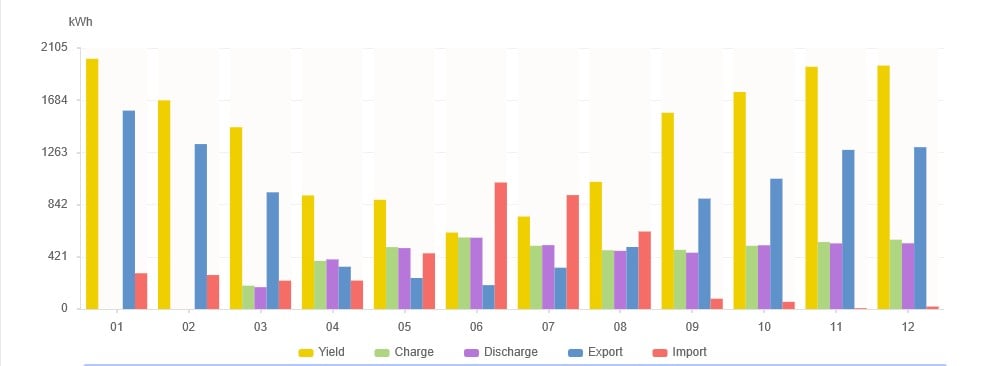
So you can compare the figures you've been provided we have 12kW(peak) of panels of a roof facing 14 to the west of due north, no shading, and approx 20 degrees pitch. So a close to perfect roof (steeper pitch would be slightly better). And a 10kW hybrid inverter, with a battery (installed March last year). The inverter's AC side is limited to the nameplate capacity i.e. 10kW but the battery means it can handle more than that on the DC side, we've seen over 11.5kW on a sunny day.


In 2025 we produced 16,600kWh - total. So there is no way that you are going to get the close to 18MWh that they are predicting with your roof orientation and tilt. Ask them what software they use and what assumptions are baked into the model.The Niwa SolarView will help you get a better estimate.


Here's our 2025 broken down by month


Otautahi Christchurch


Handle9
11991 posts

Uber Geek
+1 received by user: 9802

Trusted
Lifetime subscriber

  #3488684 8-May-2026 12:35
Send private message quote this post

Stu1:


your gas heating has a fault so worth replacing , unless your infinity is broken wait to it breaks. HWP are a tough ROI at least 10 k to install and often need replacing in 7 years. You could get three infinity’s for that price even with gas prices I will convert to bottles over losing my continuous hot water . Just not worth it unless it’s at end of life. The money you save on solar covers can offset your gas charge 


I’m doing a gas delete on one of my properties today. We have gone with a conventional cylinder and induction hob. I can’t see how a hot water heater pump makes sense with current prices. With solar the payback can be even worse as a hot water cylinder is a great place to divert excess generation. 


Handle9
11991 posts

Uber Geek
+1 received by user: 9802

Trusted
Lifetime subscriber

  #3488689 8-May-2026 13:06
Send private message quote this post

Loismustdye:


RunningMan:


Hot water and heating are usually the highest energy consumers. Given you're already using electricity for the heating, then a move to electric water heating would probably be the next thing to do, especially if the teenagers use a lot of hot water.


A larger cylinder will store more energy; if you put it on a timer or other logic to heat during the day when the sun is out that will probably get the best return.


EDIT: Consider if your cooktop can be modified to use bottled gas and that will drop your monthly connection fee.


Thanks. I hadn’t considered moving to lpg for the cooktop, the oven has been in since the house was built so it may be a bit more difficult but will check my options.


we would be looking at the biggest cylinder we could get and ideally heat it during the day with the panels.


If you do convert cooking to bottles you will likely need a conversion kit for the cooker. It’s not a big deal but they use different orifice sizes. 


Paul1977
5188 posts

Uber Geek
+1 received by user: 2210


  #3488696 8-May-2026 13:49
Send private message quote this post

Loismustdye:


@Paul1977 yes 460w panels and yes 10kw inverter. And the roof pitch is crudely 20 degrees using a level in the roof space. There’s no mention of tilt mounts in the quote but I’m assuming they are over sizing for the roof angle. System size is 13.95kw with an estimated production of 17,973kwh, performance ratio 0.81%.


I don't know exactly how much impact the roof pitch has on generation, but I'd definitely be questioning all panels on a 20 degree SE roof (veering towards SSE looking at the picture) as I would have though this is getting close to the worst orientation you could have for a single large array. As @fastbike commented, 18MWh annually sounds closer to what you'd expect with an optimal orientation.


Is it possible the outfit that quoted thought the pitch was in the other direction (if they didn't do a site visit), and modelled for a NW roof? 


EDIT: To add that our installers estimated a 14.5MWh (14,500kWh) annual production from our Christchurch system, which comprises of 11.76kW panels in total (5.88 NNE, 5.88 WNW) on a 10kW inverter. We haven't had it long enough to see if that estimate is accurate.


Loismustdye

950 posts

Ultimate Geek
+1 received by user: 256

Trusted

  #3488813 8-May-2026 16:08
Send private message quote this post

Right, just went and remeasured the roof pitch which is actually a lot less than I measured, it’s actually only about 6-8 degrees not the 20 degree decline I initially measured (no idea how I messed that up tbf) This may go some way to explaining the numbers presented as the quote (there was no site visit by the gear supplier so I assume they have just used software). 

@paul1977 potentially they may have got the direction of the pitch wrong as the gear supplier didn’t visit, however the installer did and the installer letter doesn’t state what the roof pitch etc is.


@fastbike thanks for that info on your output, I may be pushing the proverbial uphill to get close to that.


Loismustdye

950 posts

Ultimate Geek
+1 received by user: 256

Trusted

  #3488814 8-May-2026 16:10
Send private message quote this post

fastbike:


Loismustdye:


@Paul1977 yes 460w panels and yes 10kw inverter. And the roof pitch is crudely 20 degrees using a level in the roof space. There’s no mention of tilt mounts in the quote but I’m assuming they are over sizing for the roof angle. System size is 13.95kw with an estimated production of 17,973kwh, performance ratio 0.81%.


That's almost a south facing roof then. You will need frames to get any decent output but then you get shading issues so that reduces the number of rows.
Have you modeled it using data from Niwa SolarView ?


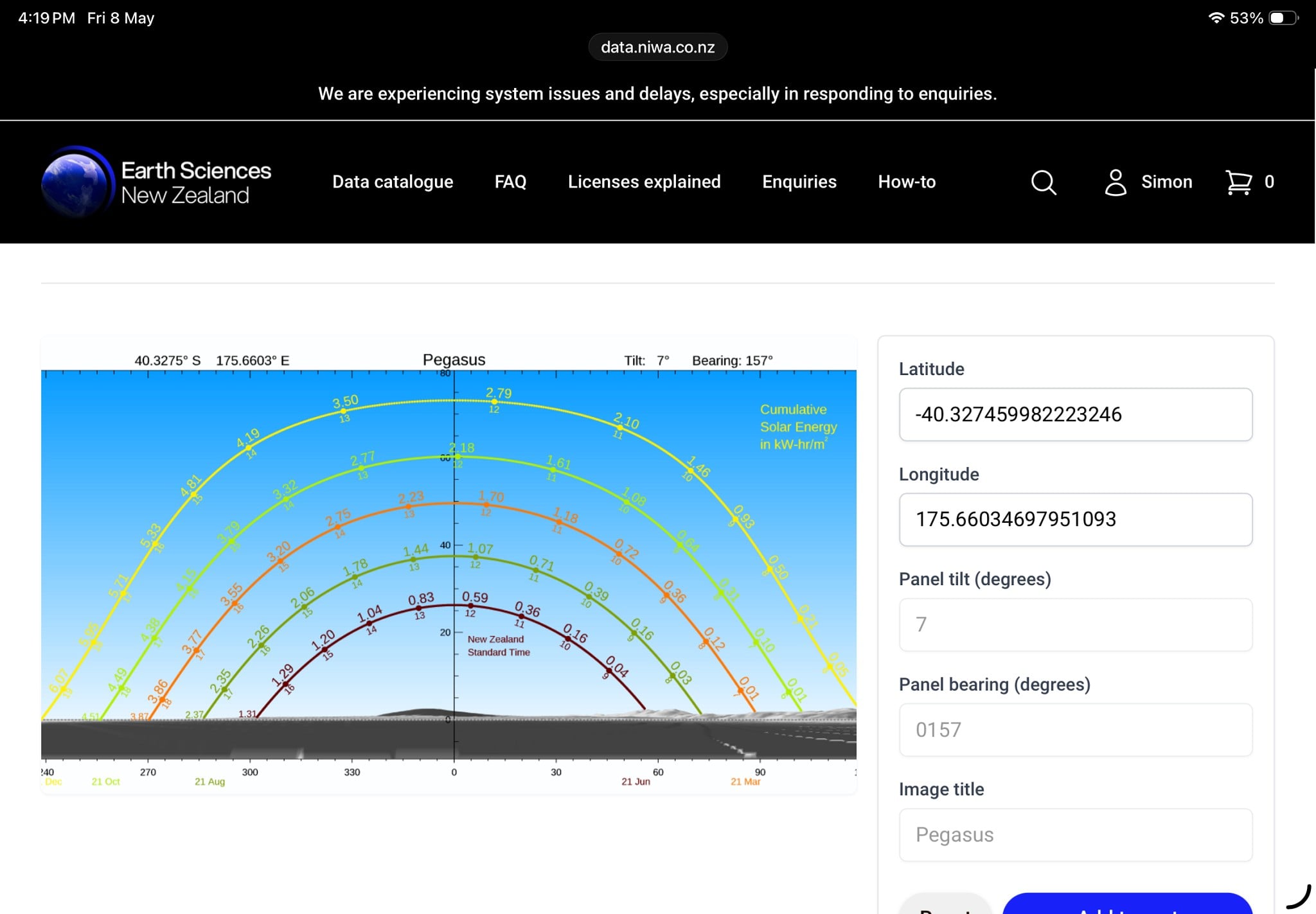
just about to have a look at solarview to see what comes out of that.


here’s the image from solarview.  


raytaylor
4084 posts

Uber Geek
+1 received by user: 1303

Trusted

  #3489108 9-May-2026 10:52
Send private message quote this post

Loismustdye:


interesting about the battery as I have wondered whether it’s of much use based on a 10kw only having $3 or so of stored power in it and whether it would be better to save that $10k and put it somewhere else.


I agree - I wouldnt bother with a battery. 
Instead I'd get a standard hot water cylinder, and night storage heaters. 
On the contact good nights plan I run our night storage heaters between 9pm-midnight and they keep the house warm overnight so we never wake up to a cold house. 

But I have been planning on getting some solar panels for our non-optimal roof and running them into the heaters during the day so I can provide an evening boost to the temperature. 


If OP uses a device such as a Paladin hot water controller, they can dump the solar production into the hot water cylinder and storage heaters at a controlled rate without importing from the grid. 


Ray Taylor

There is no place like localhost

Spreadsheet for Comparing Electricity Plans Here


raytaylor
4084 posts

Uber Geek
+1 received by user: 1303

Trusted

  #3489109 9-May-2026 11:25
Send private message quote this post

BlargHonk:


I would look at the price difference between a standard electric HWC and extra solar panels compared to getting the heat pump hot water cylinder. Especially if you have the roofspace for lots of panels. 3x energy efficiency is great, but if the energy is next to free during the middle of the day?


This is pretty much guaranteed to work better.   


Its cheaper for an extra couple of solar panels to offset the efficiency of a heat pump while also lasting much longer. 
I think the estimated lifetime of a heat pump system is about 10 years but a standard resistive cylinder will easily last 30 years. 


Ray Taylor

There is no place like localhost

Spreadsheet for Comparing Electricity Plans Here


raytaylor
4084 posts

Uber Geek
+1 received by user: 1303

Trusted

  #3489110 9-May-2026 11:32
Send private message quote this post

timmmay:


Solar panels are 25% efficient, whereas the older style systems that directly heat the water from the sun are apparently much more efficient. 


Pretty much not economic 
An evacuated tube solar collector is about 40% efficient so you can get double the heat for the same amount of roof space. 
But i'd only look at it if you are really limited for space. Its just so much more costly than buying two or three extra PV panels.  
You also dont need to get a plumber involved - the heat is transported using existing electrical wiring. 
And the benefit with the PV panels is once the water has finished heating, you can do other stuff with the electricity like export it to the grid or another useful load. 


If you were running a pool heater, motel or another system where you need to heat lots of water, then it would totally be worth it but for a residential installation where you only need four kilowatt hours of heat for water each day, easier just to add more panels. 


Ray Taylor

There is no place like localhost

Spreadsheet for Comparing Electricity Plans Here


tweake
2689 posts

Uber Geek
+1 received by user: 1145


  #3489118 9-May-2026 11:53
Send private message quote this post

raytaylor:


timmmay:


Solar panels are 25% efficient, whereas the older style systems that directly heat the water from the sun are apparently much more efficient. 


Pretty much not economic 
An evacuated tube solar collector is about 40% efficient so you can get double the heat for the same amount of roof space. 
But i'd only look at it if you are really limited for space. Its just so much more costly than buying two or three extra PV panels.  
You also dont need to get a plumber involved - the heat is transported using existing electrical wiring. 
And the benefit with the PV panels is once the water has finished heating, you can do other stuff with the electricity like export it to the grid or another useful load. 


If you were running a pool heater, motel or another system where you need to heat lots of water, then it would totally be worth it but for a residential installation where you only need four kilowatt hours of heat for water each day, easier just to add more panels. 


the problem with hot water solar is how do you turn it off when its done its job. one trick is to dump the excess heat into a swimming pool. ie the control system is difficult.


with pv, you can just turn it off or even better feed it into the grid. very easy to control or adapt the usage. 


tweake
2689 posts

Uber Geek
+1 received by user: 1145


  #3489120 9-May-2026 11:54
Send private message quote this post

raytaylor:


but a standard resistive cylinder will easily last 30 years. 


if your lucky. old one yes, but most modern ones won't.


fastbike
499 posts

Ultimate Geek
+1 received by user: 380


  #3489124 9-May-2026 12:35
Send private message quote this post

tweake:


the problem with hot water solar is how do you turn it off when its done its job. one trick is to dump the excess heat into a swimming pool. ie the control system is difficult.


with pv, you can just turn it off or even better feed it into the grid. very easy to control or adapt the usage. 


Why would you need to turn it off ? When my water is hot the temp delta across the hot water solar thermal panel drops to zero so there is no heat to be harvested, self limiting.


There is a certain elegance in solar thermal but the economics have changed  since we installed  our in 2002 


Otautahi Christchurch


tweake
2689 posts

Uber Geek
+1 received by user: 1145


  #3489126 9-May-2026 12:53
Send private message quote this post

fastbike:


tweake:


the problem with hot water solar is how do you turn it off when its done its job. one trick is to dump the excess heat into a swimming pool. ie the control system is difficult.


with pv, you can just turn it off or even better feed it into the grid. very easy to control or adapt the usage. 


Why would you need to turn it off ? When my water is hot the temp delta across the hot water solar thermal panel drops to zero so there is no heat to be harvested, self limiting.


There is a certain elegance in solar thermal but the economics have changed  since we installed  our in 2002 


i looked at it a few decades ago as mates got it installed. the simple problem is it can boil the water. the systems where designed for peak summer conditions to avoid this. that worked ok in mates case because they had wetback on the fireplace. so electric water heating only kicked in when you had cold weather but not cold enough to run the fireplace.


 but if you size the system to work outside of summer, or you have long times with no hot water usage, you can boil the water or usually the release valves opens and you dump the hot water. talking to the install crowd, on the larger ones they design in a thermal dump eg swimming pool or water tank. somewhere to dump the unwanted heat during peak summer conditions.


the PV equivalent is probably designing the panel size for winter use then feeding back to grid in summer.


1 | 2 | 3
View this topic in a long page with up to 500 replies per page Create new topic


Geekzone Live »

Try automatic live updates from Geekzone directly in your browser, without refreshing the page, with Geekzone Live now.


Are you subscribed to our RSS feed? You can download the latest headlines and summaries from our stories directly to your computer or smartphone by using a feed reader.