Geekzone: technology news, blogs, forums
Guest
Welcome Guest.
You haven't logged in yet. If you don't have an account you can register now.


neb

neb

11294 posts

Uber Geek
+1 received by user: 10018

Trusted
Lifetime subscriber

#304219 14-Apr-2023 15:38
Send private message

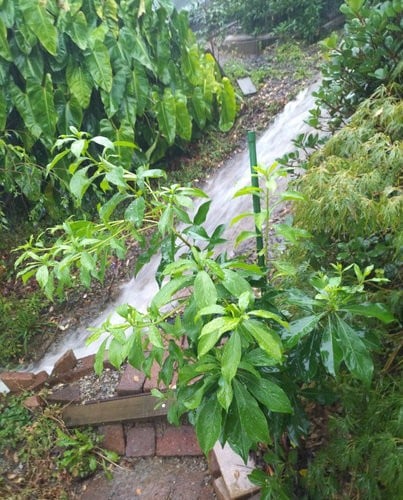
Some background info here, this is what the driveway at the Casa looks like when there's a lot of rain:


(it's called a driveway but it's really a wide footpath, it only has foot traffic). This is why it looks like this:


There's nothing Watercare can/will do to fix this, they've widened the throat in the street drains but the problem is that the water comes off the street with such force that a lot of it never gets near the drain but just shoots straight down the driveway.


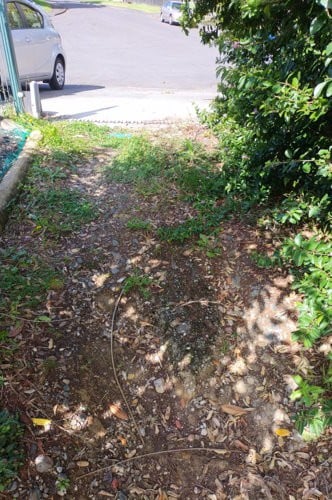
There is a channel drain at the top but either the majority of the flow shoots over the top or the 100mm pipe just isn't capable of carrying enough away to make a difference:
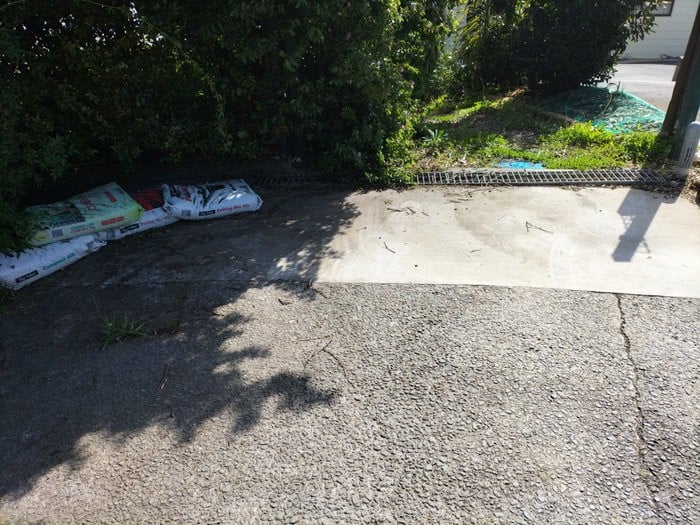


The proposed solution is to bury the largest possible pipe down the driveway, so something like 200-250mm Euroflo culvert pipe, the problem is catching it at the top to get it into the pipe. The high-level solution is a large farm-grade channel drain with two 150mm outflows teed into the Euroflo pipe, but the problem is persuading the water to go down into the channel drain rather than over the top of it.


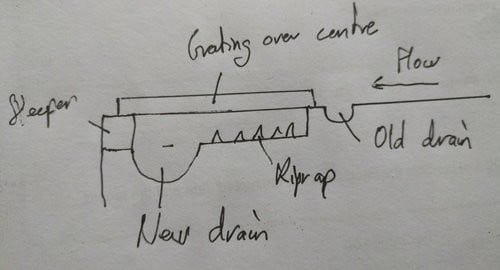
So it'd need riprap or something functionality equivalent to slow down/break up the flow and let it drop into the two drains, problem is we still need to get down to the house. One idea is to have, behind the old original channel drain, maybe half a metre of riprap in concrete, which also provides a surround for the water meter box, followed by the new, larger drain, and a galvanised grille over the centre to allow water down onto the riprap and drain but still allow foot traffic over the top:
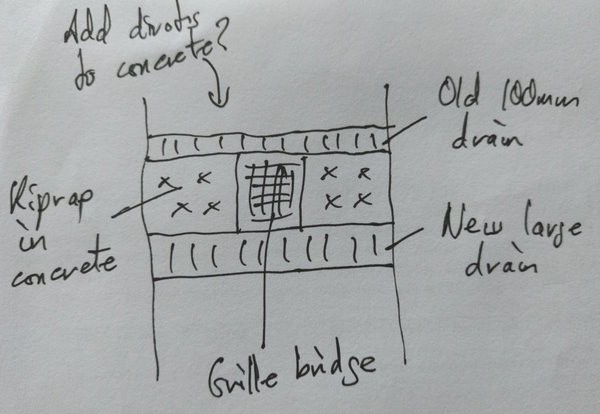


In addition it'd be good to add divots or low lumps to the concrete in front of the first drain to start breaking it up there, however I'm not sure that that would involve, screwing on a pile of catseyes will do the job but look pretty messy, I'm not sure what other options there are.


Any ideas? This has infinite bikesheddability so concrete pointers would be useful.

View this topic in a long page with up to 500 replies per page Create new topic
 1 | 2
tweake
2641 posts

Uber Geek
+1 received by user: 1137


  #3063683 14-Apr-2023 16:24
Send private message

for a temp fix i would put sand bags just behind the drain. as its foot traffic people can step over it. thats just to provide a wall so it can go into the drain. i would curve it a bit so it doesn't go down your neighbours drive. simply to give you time over winter to do something more permanent. 


an odd ball option, depending on how much water goes down there and its speed, is to install angled blocks. much like what you see on dam spillways, its to break up the high speed flows. this doesn't change the direction, just turn a fair bit of it into rain/spray. that will help dissipate some of the energy and slow it down.


neb

neb

11294 posts

Uber Geek
+1 received by user: 10018

Trusted
Lifetime subscriber

  #3063698 14-Apr-2023 16:27
Send private message

This is supposed to be a permanent solution, running 30m of 250mm pipe isn't a quick fix :-). The current temporary solution is (barely) visible in the first photo (it was rebuilt after that to make it even more solid), massive brick water diversion barriers back by several m3 of hardfill.

tweake
2641 posts

Uber Geek
+1 received by user: 1137


  #3063708 14-Apr-2023 17:07
Send private message

keep in mind its hard to tell size and slope from photos.


for permanent, your idea is ok. hard to tell what room you have to work with. i don't know what work you can do road side of existing drain.


you need to slow that water down as much as possible otherwise no matter what drain you install it will hit it and spill over it like its doing now. having the centre bit a bit shallow may help to hold a bit of water to help give it something to crash into. try to get that water to be turbulent so it slows down.


for pipes i would not use any smooth pipe. a lot of that Euroflo is smooth inside. great for flow but not great in this application. you want water to go a bit slower and be turbulent. that turbulence helps keep the pipe clean. 


neb

neb

11294 posts

Uber Geek
+1 received by user: 10018

Trusted
Lifetime subscriber

  #3063769 14-Apr-2023 21:17
Send private message

tweake:

keep in mind its hard to tell size and slope from photos.


you need to slow that water down as much as possible otherwise no matter what drain you install it will hit it and spill over it like its doing now. having the centre bit a bit shallow may help to hold a bit of water to help give it something to crash into. try to get that water to be turbulent so it slows down.


for pipes i would not use any smooth pipe. a lot of that Euroflo is smooth inside. great for flow but not great in this application. you want water to go a bit slower and be turbulent. that turbulence helps keep the pipe clean. 


Ah, good point, the camera makes it look quite shallow when in fact it's about 15 degrees near the top and quickly becomes staircase-required further down. I'll take some measurements and post more details tomorrow, it's around 1.8m wide.


For the pipes, I definitely want to use smooth pipes because a ton of debris washes down there, I pull about 2-3 10-litre buckets of debris off the street drains every time it rains so I want a clear, unobstructed path all the way down. I'll add baffles or something at the bottom to slow things down again but I don't want debris getting jammed about 10-15m into the pipe where it'll be almost impossible to clear.


I appreciate the need to slow it down before it hits the drains, that's the problem I'm trying to solve in terms of the best way to do that. I'd really like to add something to the very flat smooth concrete before the first drain, but not really sure what'd be best.

tweake
2641 posts

Uber Geek
+1 received by user: 1137


  #3063816 15-Apr-2023 10:16
Send private message

neb: Ah, good point, the camera makes it look quite shallow when in fact it's about 15 degrees near the top and quickly becomes staircase-required further down. I'll take some measurements and post more details tomorrow, it's around 1.8m wide. For the pipes, I definitely want to use smooth pipes because a ton of debris washes down there, I pull about 2-3 10-litre buckets of debris off the street drains every time it rains so I want a clear, unobstructed path all the way down. I'll add baffles or something at the bottom to slow things down again but I don't want debris getting jammed about 10-15m into the pipe where it'll be almost impossible to clear. I appreciate the need to slow it down before it hits the drains, that's the problem I'm trying to solve in terms of the best way to do that. I'd really like to add something to the very flat smooth concrete before the first drain, but not really sure what'd be best.


 Corrugated Pipe doesn't clog up like you think it would. often its the smooth pipe that clogs. there is some good video footage of this around, i try to find it. the turbulence generated by the corrugations keeps the leaves etc moving, compared to the smooth pipe where they tend to sit and water goes around them leaving it behind. the real downside is  Corrugated Pipe flows less for the size due to all that turbulence, so you need a larger size which costs more. however thats unlikely to apply in your case as your going oversized anyway.


to break up the flow at the top, dimples or smooth pebbles etc is not good. you want harsh edges, ie brick like. probably something that breaks ankles. 


https://youtu.be/dc9fcbNfN1I french drain main video.


Shop now on Samsung phones, tablets, TVs and more (affiliate link).
jonherries
1433 posts

Uber Geek
+1 received by user: 316

Trusted
Subscriber

  #3063819 15-Apr-2023 11:01
Send private message

I wonder instead of rirap, I have seen flat small riverstones planted on their edge (rather than flat) in old barns etc. You could arrange them in corrugations in the concrete and that would slow the water more?

Jon


Bung
6733 posts

Uber Geek
+1 received by user: 2926

Subscriber

  #3063879 15-Apr-2023 13:12
Send private message

neb: There's nothing Watercare can/will do to fix this, they've widened the throat in the street drains but the problem is that the water comes off the street with such force that a lot of it never gets near the drain but just shoots straight down the driveway.


If the water was coming down your drive they would likely insist in you fixing it. Why should you have to engineer a solution to their problem? If they can't stop the water before it flows over the footpath could they contribute?

neb

neb

11294 posts

Uber Geek
+1 received by user: 10018

Trusted
Lifetime subscriber

  #3063890 15-Apr-2023 13:57
Send private message

tweake:

 Corrugated Pipe doesn't clog up like you think it would. often its the smooth pipe that clogs. there is some good video footage of this around, i try to find it. the turbulence generated by the corrugations keeps the leaves etc moving, compared to the smooth pipe where they tend to sit and water goes around them leaving it behind. the real downside is  Corrugated Pipe flows less for the size due to all that turbulence, so you need a larger size which costs more. however thats unlikely to apply in your case as your going oversized anyway.


What's washed down there isn't just a few leaves and debris, after each rainfall I clear 2-3 10-litre buckets of stuff from the street drains which are about 50% covered over with it, things up to the size of the base of a Bangalow palm frond, the large scoop-shaped thing (not a full-sized one, maybe 40-50cm long). So I really don't want anything catching in there and then further debris that follows blocking the pipe. Given that I'd guess the flow there once there's enough water coming down to cause it to flood is 5 m/s or more, so at least 20kmh - it's at a level where you'd be knocked off your feet if you tried to cross it - I doubt anything will have a chance to settle anywhere.

neb

neb

11294 posts

Uber Geek
+1 received by user: 10018

Trusted
Lifetime subscriber

  #3063902 15-Apr-2023 14:57
Send private message

Bung: If the water was coming down your drive they would likely insist in you fixing it. Why should you have to engineer a solution to their problem? If they can't stop the water before it flows over the footpath could they contribute?


The drive is a designated overland flow path, it's just never had any flow down it until the last few years. The neighbours who have lived here for close to 50 years say they've never seen it overflow before now in the entire time they've been here, so until quite recently the whole thing was just an annotation on a 1970s plan.


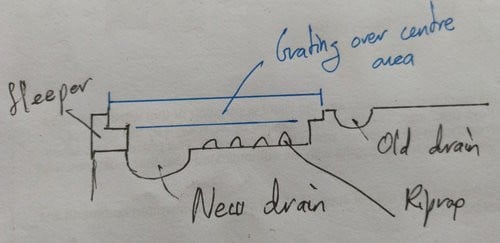
Current thinking is to have the second drain backed by a redwood sleeper so any flow that doesn't drop into the drain hits that and goes (mostly) down, while still leaving the ability for water to overtop it if there's a lot of flow or the drain gets blocked. There'd be a grating over the centre as a kind of drawbridge to walk over:


(Drawn with a damaged hand so it's a big messy). So the grating/drawbridge is higher than anything else so water will mostly flow down the sides, some may splash up onto the grating but will then fall down into the drain area. The reason for having it raised at least a bit is that if it's down at the same level as the flow then it'll get blocked with debris, although if that's not as big a deal than a better option would be to cut a rebate into the edge of the sleeper and drop it into that rather than having it sitting on top.

neb

neb

11294 posts

Uber Geek
+1 received by user: 10018

Trusted
Lifetime subscriber

  #3063903 15-Apr-2023 15:00
Send private message

jonherries: I wonder instead of rirap, I have seen flat small riverstones planted on their edge (rather than flat) in old barns etc. You could arrange them in corrugations in the concrete and that would slow the water more?


Was thinking of rounded river rocks since I don't want to create a field of caltrops across the driveway - I was using riprap as a generic term meaning "stuff to break up water flow".


Shop now for Lego sets and other gifts (affiliate link).

neb

neb

11294 posts

Uber Geek
+1 received by user: 10018

Trusted
Lifetime subscriber

  #3063911 15-Apr-2023 16:01
Send private message

tweake:

keep in mind its hard to tell size and slope from photos.


So the "flat" bit at the top has a 7 degree slope, rapidly becoming 13 degrees, then 21 degrees when it gets to the house, and finally a long stretch at 14-16 degrees before it levels out a bit.


Latest thinking, still drawn with damaged hand:


A related question to this, the builders - who aren't landscapers - put in some low retaining walls in an area that's permanently shaded and quite damp:


They nicely bevelled the edges of the posts but just cut them flat, which means they'll eventually end up like all of the round Casa original posts next to them, rotted out at the centre. Apart from cutting a slope into them I'd like to add some extra protection to extend their life a bit, for which options include:


- Clear Metalex on the top surfaces.


- Bitumen paint on the ends of the square posts (on top of the Metalex above).


- Capping the posts and flat surfaces, either with timber or metal flashing.


I'm not too keen on the capping because with timber it'll further narrow an already somewhat narrow deck, with metal it's at ankle height which could be damaging if you run into it. Currently I'm thinking Metalex on the top surface and bitumen sealer on the top of the posts. Yeah, they'll be black on the ends but that's not a big deal, some of the other posts are already sealed that way and it's not that bad.

tweake
2641 posts

Uber Geek
+1 received by user: 1137


  #3063918 15-Apr-2023 16:10
Send private message

neb: The drive is a designated overland flow path, it's just never had any flow down it until the last few years. The neighbours who have lived here for close to 50 years say they've never seen it overflow before now in the entire time they've been here, so until quite recently the whole thing was just an annotation on a 1970s plan. Current thinking is to have the second drain backed by a redwood sleeper so any flow that doesn't drop into the drain hits that and goes (mostly) down, while still leaving the ability for water to overtop it if there's a lot of flow or the drain gets blocked. There'd be a grating over the centre as a kind of drawbridge to walk over:  (Drawn with a damaged hand so it's a big messy). So the grating/drawbridge is higher than anything else so water will mostly flow down the sides, some may splash up onto the grating but will then fall down into the drain area. The reason for having it raised at least a bit is that if it's down at the same level as the flow then it'll get blocked with debris, although if that's not as big a deal than a better option would be to cut a rebate into the edge of the sleeper and drop it into that rather than having it sitting on top.


no need for riprap in the drain if you concrete it. it only needs to be there if you have bare soil. ie dig the sump out and line bottom and sides in riprap, or concrete the bottom and sides. its only there to stop the soil being eroded away.


make the sump as deep as you can, no need to have a drain channel inside it. have the drain pipe connect to the side.


you can't have a grate sitting up like that, the sides of the grate will stop water flowing in. water has to flow over the grate for water to go in. one small trick is to put it on a slight slope. make sure the back is well secured so it doesn't get pushed off.


if possible put riprap or chunky blocks before the old drain. or even just after it. kick some of that high speed water up into the air. the earlier you can disrupt the flow, remove energy from it, the more likely you can get water to go into both drains.


i'm assuming your talking about quite shallow depth of water coming off the street at high speed.


tweake
2641 posts

Uber Geek
+1 received by user: 1137


  #3063920 15-Apr-2023 16:17
Send private message

neb:
jonherries: I wonder instead of rirap, I have seen flat small riverstones planted on their edge (rather than flat) in old barns etc. You could arrange them in corrugations in the concrete and that would slow the water more?
Was thinking of rounded river rocks since I don't want to create a field of caltrops across the driveway - I was using riprap as a generic term meaning "stuff to break up water flow".


round river rocks works fine for helping stop soil erosion, which is what riprap is for . for breaking up water flow you want sharper edges and angled up. have a look at spill ways, they slope the last bit up to fire the water up into the air. some that have space constraints will have big blocks at the end to help disperse the water up. smooth rocks won't help because it doesn't disturb the water enough.


tweake
2641 posts

Uber Geek
+1 received by user: 1137


  #3063921 15-Apr-2023 16:21
Send private message

neb:
tweake:


keep in mind its hard to tell size and slope from photos.


So the "flat" bit at the top has a 7 degree slope, rapidly becoming 13 degrees, then 21 degrees when it gets to the house, and finally a long stretch at 14-16 degrees before it levels out a bit. Latest thinking, still drawn with damaged hand:  


so i take it that there is a 7 degree slope from the old drain down to the sleeper, hence the need for the sleeper to keep the grate level.


the front of the grating needs to be dropped down to ground level.


 1 | 2
View this topic in a long page with up to 500 replies per page Create new topic


Geekzone Live »

Try automatic live updates from Geekzone directly in your browser, without refreshing the page, with Geekzone Live now.


Are you subscribed to our RSS feed? You can download the latest headlines and summaries from our stories directly to your computer or smartphone by using a feed reader.