|
|
|
#include <std_disclaimer>
Any comments made are personal opinion and do not reflect directly on the position my current or past employers may have.
hio77: The process itself wasn't as I expected. But my advice is just as I said to my partner at the time. Sit back, let them do it.
You mean you thought that it was your nose they shoved the probe up into? Yeah, a lot of people make that mistake.
Seriously though, what was the sample-collection process like?
neb:hio77: The process itself wasn't as I expected. But my advice is just as I said to my partner at the time. Sit back, let them do it.You mean you thought that it was your nose they shoved the probe up into? Yeah, a lot of people make that mistake. Seriously though, what was the sample-collection process like?
it is simply a nose swab, it's just what i'd say is a little further than expected. (takes all of 10 seconds)
Probably totally normal for one to be honest, but it's certainly my first one. i could make many light jokes about it all, but honestly i wouldn't want it to be misconstrued and thus put anyone off being tested.
so i'll simply put it as, If you are potentially infected, get tested. let the process happen and it's over and done with quickly.
worth noting, i HATE my nose being touched. even my partner, it's just a nogo.
I'd personally have taken a blood over it (and i will run for the hills at mention of that.)
the nurses there, who atleast for me were mainly school nurses redeployed do their absolute best to make it as comfortable as possible.
they are well protected, have a good process to ensure the sample doesn't put them at risk.
#include <std_disclaimer>
Any comments made are personal opinion and do not reflect directly on the position my current or past employers may have.
floydbloke:
kobiak:
I wonder if they should do random supermarket testing for people in the queues. ...
@kobiak Are you talking voluntary or forcing people to have a test?
I have not had one myself but I understand it's rather unpleasant, to the point of being painful, and I suspect quite a few people to be averse to being told "you're next".
I've had it - its not bad. If it saves lives then people shouldn't use slight "pain" as an excuse....

Zeon:
I've had it - its not bad. If it saves lives then people shouldn't use slight "pain" as an excuse....
My motivation for asking was that there was a discussion some time ago of it not being so pleasant, and in response one of the medical folks explained that maybe they weren't doing it right, presumably due to inexperience in the initial days of testing. Just wanted to check what the current state of play was.
@hio77 experience was a little different to mine.
I'd developed a bit of a cough a few days ago, thought very unlikely to be Covid but did the right thing and called GP. They said they were testing anyone with any respiratory symptoms now, so said someone would phone me to tell me what testing centre to go to and what time.
Got a call not long after. The closest testing centre happened to be my GPs practice and that's where they sent me. They gave me a phone number and said to call the number from my car once I was in the parking lot.
Once I arrived I called the number and they said to wait in my car and they would call me back when they were ready for me. They called me back about 20 min later saying someone would meet me at the door where i could sanitise my hands and they would give me a mask. So I went to the entrance, and they let me in (they opened the automatic door from the inside so no-one can just walk in) i used some hand santiser and a Dr in full PPE gave me a mask and told me how to properly put it on and then escorted me to a private room.
The entire GP practice had been made up like Dexter's kill room, so they were taking appropriate measures on all fronts from what I could tell.
Went through a bunch of questions; checked breathing, oxygen levels, heart rate, temperature, etc. Then the nasal swab. I'll be honest, not the most pleasant experience, but over quickly - I wouldn't call it painful, just an unusual and uncomfortable sensation for a few seconds. Nothing that should put you off getting tested.
Hand santiser again and instructions to stay fully isolated until you get results, and then even if negative stay isolated until 48 hours after symptoms stop.
At no point throughout the entire time was I anywhere near anyone else except for the one doctor in PPE.
Got text message about 24 hours later with a negative result.
I found the entire process very good.
Paul1977:
@hio77 experience was a little different to mine.
and that's exactly it, it may differ for everyone depending on what all they are setup and prepared for.
#include <std_disclaimer>
Any comments made are personal opinion and do not reflect directly on the position my current or past employers may have.
neb:and in response one of the medical folks explained that maybe they weren't doing it right, presumably due to inexperience in the initial days of testing.
Honestly that's probably exactly my experience too.
they were school nurses doing it, i'm sure they are well trained but hey, doing that to someone by my eye, probably requires quite a bit of practice to have it right.
#include <std_disclaimer>
Any comments made are personal opinion and do not reflect directly on the position my current or past employers may have.
This is a 3D simulation of a spreading in a supermarket (or elsewhere) https://www.youtube.com/watch?v=WZSKoNGTR6Q
- NET: FTTH & VDSL, OPNsense, 10G backbone, GWN APs
- SRV: 12 RU HA server cluster, 0.1 PB storage on premise
- IoT: thread, zigbee, tasmota, BidCoS, LoRa, WX suite, IR
- 3D: two 3D printers, 3D scanner, CNC router, laser cutter
tdgeek: ... Thanks for the detail, appreciated. What I meant, via poor gramma, was that per capita, we have a larger number of clusters. We have 480 odd of the 1300 odd cases are from 15 clusters. That seems really high. If you look at a country where COVID-19 has run rampant, no doubt there are many clusters but you'd expect most of it is CT. We appear to have very low CT, which means our lockdown is giving us a level of control, but our numbers are inflated by so many clusters, or more to the point, that our few cluster cases are a significant proportion of our total cases. Over one third are from potentially avoidable clusters. The other 4.7 million of us have produced less than double the cases than clusters.
Maybe Im barking up the wrong tree. We imported all our cases, as all countries have. A portion of our cases are second and third generation infections, from travellers. Ok thats what a virus does. If you take our 1300 cases, remove the infections we imported, remove the clusters that were avoidable, you would seem to get a low number left, which is natural, internal spread. I.e. what the imported infections spread once the travellers arrived here.
Again, facts will provide a better perspective of NZ cases. Figures below are for ~13 Apr.
"per capita, we have a larger number of clusters. We have 480 odd of the 1300 odd cases are from 15 clusters. That seems really high. ... or more to the point, that our few cluster cases are a significant proportion of our total cases."
NZ 15 clusters with 10 or more cases. Total number in those clusters = 498 (36% of total cases)
Singapore (only slightly larger population), 16 clusters with 10 or more cases. Total number in those clusters = 1,269 (43% of total cases)
Australia - yet to find comprehensive details for their clusters
South Korea, again I do not have full details. The 'number of clusters per capita' may be smaller but that is not particularly relevant. The total number of cases in clusters is more relevant in this respect. As per my post that you replied to, clusters there account for over 81% of total cases so are much more significant than in NZ.
So no, '480 odd of the 1300 odd cases' is not 'really high'.
'If you take our 1300 cases, remove the infections we imported, remove the clusters that were avoidable, you would seem to get a low number left'
NZ clusters with 10 or more cases = 36% of total cases, imported = 39%. Ignoring overlap (some clusters include imported cases) = 75% of our 279 total cases per million population. Hence residual ("number left") = ~69 cases pm
South Korea (13 Apr). Total =10,537 cases . Other than clusters or imported = 1,020 (9.7% of total) = ~20 cases pm (a few small clusters removed but they will have little effect on this)
Taiwan (14 Apr). Total = 393 cases, other than imported = 55 cases = 2.3 cases pm (ignore clusters, if any!)
Hong Kong (14 Apr). Total = 1031 cases, other than imported = 420 = 56 cases pm (removing clusters will lower this figure but I do not have details of their clusters)
Australia (14 Apr). Excluding on imported cases (64.2%) = 90 cases pm. Need to take clusters out of that but I do not have the info.
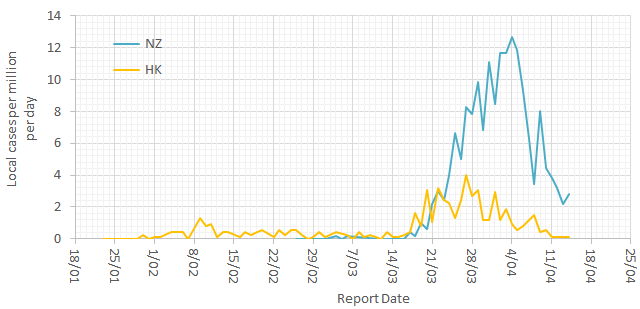
As the data show, there is nothing special about NZ in respect of local, non-cluster cases. Our figure of 69 cases pm is a bit higher than Hong Kong and far from the lowest.
And as per plot below, local cases in HK have reduced to near zero over the last couple of days

That is quite interesting. I would expect to see NZs cases to be getting close to zero soon. I don't think going out of lockdown level 4 with new cases still occurring will be very popular.
But I suspect resthomes and other type of institution are where quite a few clusters are, are where new infections are occurring, and they are essentially big bubbles, shared with staff bubbles, where the virus moves slowly through the population. SO it could take many weeks for teh virus to go through the population
I am not sure if these other countries compared here, have rest homes like NZ, by resthomes are also an issue in the UK and the US with this virus.
I noticed when I was living in Japan, that it was quite common for multi generation household, where elderly parents lived with the family, and I don't think resthome are as common in Asian countries. That potenaily could make a big difference
DS248:
tdgeek: ... Thanks for the detail, appreciated. What I meant, via poor gramma, was that per capita, we have a larger number of clusters. We have 480 odd of the 1300 odd cases are from 15 clusters. That seems really high. If you look at a country where COVID-19 has run rampant, no doubt there are many clusters but you'd expect most of it is CT. We appear to have very low CT, which means our lockdown is giving us a level of control, but our numbers are inflated by so many clusters, or more to the point, that our few cluster cases are a significant proportion of our total cases. Over one third are from potentially avoidable clusters. The other 4.7 million of us have produced less than double the cases than clusters.
Maybe Im barking up the wrong tree. We imported all our cases, as all countries have. A portion of our cases are second and third generation infections, from travellers. Ok thats what a virus does. If you take our 1300 cases, remove the infections we imported, remove the clusters that were avoidable, you would seem to get a low number left, which is natural, internal spread. I.e. what the imported infections spread once the travellers arrived here.
Again, facts will provide a better perspective of NZ cases. Figures below are for ~13 Apr.
"per capita, we have a larger number of clusters. We have 480 odd of the 1300 odd cases are from 15 clusters. That seems really high. ... or more to the point, that our few cluster cases are a significant proportion of our total cases."
NZ 15 clusters with 10 or more cases. Total number in those clusters = 498 (36% of total cases)
Singapore (only slightly larger population), 16 clusters with 10 or more cases. Total number in those clusters = 1,269 (43% of total cases)
Australia - yet to find comprehensive details for their clusters
South Korea, again I do not have full details. The 'number of clusters per capita' may be smaller but that is not particularly relevant. The total number of cases in clusters is more relevant in this respect. As per my post that you replied to, clusters there account for over 81% of total cases so are much more significant than in NZ.
So no, '480 odd of the 1300 odd cases' is not 'really high'.
As the data show, there is nothing special about NZ in respect of local, non-cluster cases. Our figure of 69 cases pm is a bit higher than Hong Kong and far from the lowest.
DS248,
I think the point that tdgeek was making was against countries where CV-19 has exploded. ie countries such as USA, Italy, Spain, UK etc. The countries you have chosen as your fact based comparisons are ones I would say are comparable to NZ in terms of spread of the disease and controls and as such, it would be expected that we have comparable profiles and was not the point tdgeek was trying to make.
Yes we are nothing special in respect of local, non-cluster cases against those selectively chosen countries - but what about NY for example.
mattwnz:That is quite interesting. I would expect to see NZs cases to be getting close to zero soon. I don't think going out of lockdown level 4 with new cases still occurring will be very popular.
But I suspect resthomes and other type of institution are where quite a few clusters are, are where new infections are occurring, and they are essentially big bubbles, shared with staff bubbles, where the virus moves slowly through the population. SO it could take many weeks for teh virus to go through the populationI am not sure if these other countries compared here, have rest homes like NZ, by resthomes are also an issue in the UK and the US with this virus.
I noticed when I was living in Japan, that it was quite common for multi generation household, where elderly parents lived with the family, and I don't think resthome are as common in Asian countries. That potenaily could make a big difference
question: what happens if after weeks of lockdown cases are not zero.
you see even in lockdown people are meeting - during essential activity, and people breaking bubble intentionally or unintentionally
we don't seem to get info on these new cases like we did at the start - how did they get them? where the contacts are?
Batman:
question: what happens if after weeks of lockdown cases are not zero.
you see even in lockdown people are meeting - during essential activity, and people breaking bubble intentionally or unintentionally
we don't seem to get info on these new cases - how did they get them? where the contacts are?
They're reporting "clusters" separately when they're >10 cases, but presumably there are many other smaller clusters traced back to an index patient with overseas travel history or contact with known case etc.
I guess if cases aren't zero then they'll need to have a good grip on remaining untraced cases / small clusters so have high confidence that they've isolated and contained them.
If there were untraced/untraceable cases diagnosed weeks ago with no known transmission route, then you have to take a punt that they got it from either fomite transmission or from an undiagnosed but now resolved / no longer contagious case that would have been picked up by now if it had been the start of new spread. If there are recent untraceable cases then they probably won't end or ease lockdown - if they are sticking with the plan to eliminate the disease.
|
|
|