Geekzone: technology news, blogs, forums
Guest
Welcome Guest.
You haven't logged in yet. If you don't have an account you can register now.


RUKI

1405 posts

Uber Geek
+1 received by user: 422


#323080 23-Oct-2025 11:00
Send private message

Tire Pressure Monitoring System or TPMS in moderns vehicles - convenience, nuisance and rip off all together. Sharing my observations, R&D results and solutions for some issues.


I had numerous cars for decades which did not have TPMS. It simply did not exist when I first got my DL. With driving experience in extreme weather conditions (using spike tyres for months and chains regularly) I can tell just by looking at the tyre - how inflated/deflated it. I can fill the subtle change in driving if the tyre is deflated. 


It is mandatory nowadays in some countries for cars to have TPMS. It is not mandatory in New Zealand.


In New Zealand though (from experience) you may find two similar makes/models – one made for UK (with TPMS) and another imported from Japan (where TPMS is not mandatory).


Many modern cars have no spare tyre. Glue (from the puncture repair kit) damages TPMS sensor and it needs replacement.


Batteries in original TPMS sensors are special long life ones and could last from 5 to 10 years. When it dies, battery is not supposed to be changed by the user, they are compound filled and can only be brutally dismantled.


When one sensor dies, TPMS light is ON, sometimes with additional warning on the LCD screen inside speedometer. WOF will fail (Was told by Nissan Leaf & Lexus owners).


Change set of tyres for whatever reason – without TPMS – light is ON.


Aftermarket sensors (e.g from Ali) – gamble & unreliable – could last 1 month as anything with batteries from PRC. Personally would never choose that option.


Original TPMS sensors (Hyundai, Nissan, Toyota, Suzuki) – are in $275 + GST range per one (as quoted in person by official dealerships in Auckland). Lexus – even more (friend was quoted >$2000 to change all 4)! Plus tyre shop fee to change it – around $80 per tyre, plus scan tool to pair new sensor, which will not be picked up automatically. That is where the “convenience” turns into “nuisance”.


And what about convenience? In Hyundai (e.g. Ioniq) or Suzuki (e.g. SWIFT) – individual tyre pressure is displayed on the Instrument Cluster. That’s great. In modern Toyota with 2 color LCD displays (e.g Prius 50-55 series) – there is only TPMS light (aka mad jelly fish) and no info about individual tyre pressure. When it pops up during heavy rain at night – good luck checking all 4 tyres for punctures. Even worth – you plug Toyota Techstream scanner – you see the list of 4 sensors’ serial number and their pressures without (!) telling which one tyre it is. What a nuisance! Its like using electronic devices to check if your soup is salty enough, whereas you can just make a sip.


Did some research, tests and programming. At his stage:


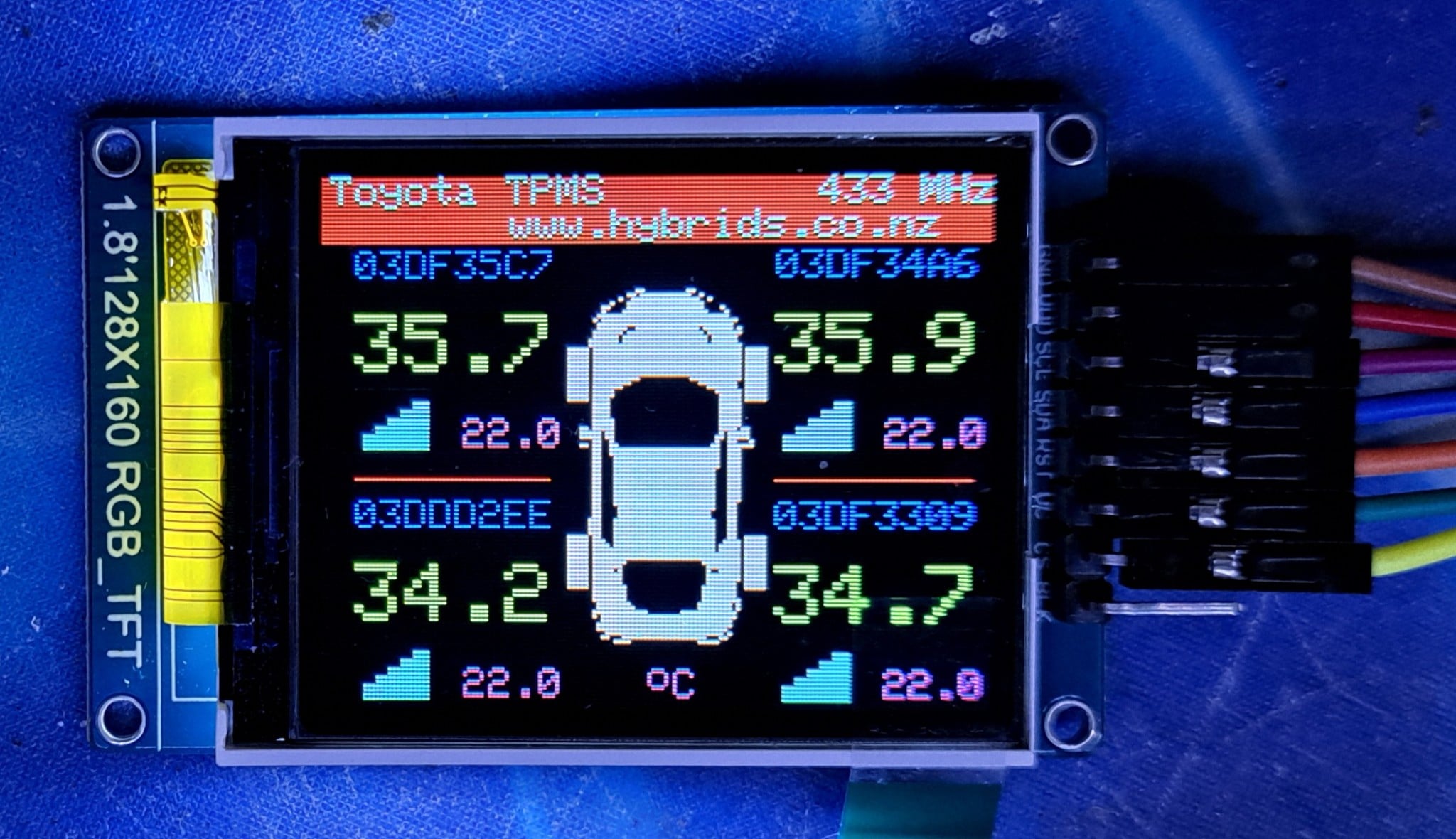
-          Designed the standalone miniature monitor (plugs into USB for power) which reads Toyota/Lexus genuine TPMS sensors remotely (no need to plug into OBD), correctly displays which tyre it is, pressure, temperature and signal strength; Super convenient!


-          Designed TPMS light ”remover” for future use when TPMS sensors fails. It plugs to the OBD and simulates normal TPMS conditions. Tested on the bench with Toyota and Lexus Instrument Clusters (2015 Lexus and 2020 Toyota). Have not tested on the live vehicle yet. Will not work on old Lexus where comms are not via CAN Bus.


-          Managed to un-program TPMS warnings from the Instrument Clusters in


o   Hyundai Ioniq (2017);


o   Nissan Leaf UK Import (2016-2019);


o   Suzuki Jimny UK Import (2019);


o   SWIFT AT (2017)


o   Honda FIT (2020- 2022).


Drivers nowadays seems to be urged to rely on all sorts of electronic monitoring.


As a side note: in the past our speedometer had just a few warning lights. Nowadays – it is an extension to the user manual. I have been recently developing conversion to English for another 2024 Japanese import – over 850 Japanese phrases – detailed text pop-up instructions related to moderns so called “safety” features and various car systems (from 12V Charge system to Cruise Control, Lane Departure, Assisted Brakes and TPMS as well) - what is working, what is not, why not working, when will be working, what to do next. None of those are even mentioned in the user manual.


I guess the next generation of drivers will look at the flat tyre and will not even know if it is good or not, would not know where the 12V Battery is located (e.g. under the rear seat in Aqua) or what the fuse looks like & where to find it (e.g. if their smart phone stopped being charged).


Happy driving!


Toyota / Lexus Hybrid and EV Battery Expert Battery Test & Repair 


Create new topic
Eva888
2761 posts

Uber Geek
+1 received by user: 2422

Lifetime subscriber

  #3427422 23-Oct-2025 11:46
Send private message

Reading that made me nervous about my Lexus. It’s getting serviced next month is there anything special I should ask them to do or look at?


Thanks for all your updates.


gzt

gzt
18674 posts

Uber Geek
+1 received by user: 7809

Lifetime subscriber

  #3427447 23-Oct-2025 12:47
Send private message

That issue sounds like something that might come up in my 2nd gen leaf just coming up to the 10 year mark now.

David321
507 posts

Ultimate Geek
+1 received by user: 105


  #3427451 23-Oct-2025 13:20
Send private message

I have a Mazda CX5 which is now 11 years old, it has tyre pressure monitoring and gives an alert when the tyres are a little flat. I can reset it by holding the tyre presure button. I never gave any consideration to the battery life of the sensors but I know that some cars (possibly my CX5) can also measure tyre inflation by rotation of the tyre, for example a flatter tyre spins faster (or possibly slower) than the other inflated tyres, I guess in that case there would be no batteries to worry about.


_David_


richms
29098 posts

Uber Geek
+1 received by user: 10207

Trusted
Lifetime subscriber

  #3427463 23-Oct-2025 14:36
Send private message

Saved me from driving on a slow leak twice in the tesla. Had I not had the warning and topped it up I would have probably had tyre damage before I noticed it like happened with my ute, and that was an expensive thing because it was a near new tyre and they decided not repairable due to the sidewall damage.


Also screw you builders next door that seem to just sweep things onto the road when cleaning up your building site.


Richard rich.ms

RUKI

1405 posts

Uber Geek
+1 received by user: 422


  #3427559 23-Oct-2025 17:17
Send private message

@David321 


Some cars have no physical TPMS sensors and the deflation is captured based on other metrics.


Toyota / Lexus Hybrid and EV Battery Expert Battery Test & Repair 


jonherries
1433 posts

Uber Geek
+1 received by user: 316

Trusted
Subscriber

  #3427573 23-Oct-2025 19:50
Send private message

Yep in CX-5 it is done by the ABS/traction control sensors.


Jon


Shop now at Mighty Ape (affiliate link).

pdh

pdh
440 posts

Ultimate Geek
+1 received by user: 289


  #3427597 23-Oct-2025 21:55
Send private message

I absolutely loved the TPMS on the RAM truck that I bought and used in North America in 2015, 16 & 17.
Over 13 months of travelling (doing nearly 6000 km per month), it was very nice to have.


The most valuable day was on the Dempster Highway in the Yukon - when a slow leak dropped a rear tyre from 80 psi (yes !) slowly down to 40. As the road surface was 50 mm of chocolate mousse on top of washboard flint... the driving characteristics of the truck were not really changing ;-)


It was more like driving a speed boat fast over a rough chop.


As it was pouring with rain and everything was covered with at least an inch of mud - including the spare tyre racked under the rear, and especially the punctured tyre - I chose to use my small electric pump to run the tyre back up to 70 psi. I did that 3 times before getting to Inuvik, where I had the puncture fixed.


Having the TPMS allowed me to track the leakage and manage the situation.


For those of you unfamiliar with the Dempster, it's 750 km long with one gas pump / cafe / motel / tyre repair shed halfway.


In less extreme circumstances, I found it useful daily:


The TPMS was accurate enough to show me the tyres warming up in the morning - as highway speeds warmed them up.


As I moved from cold weather areas - snow in the Rockies to to deserts (eg: Death Valley) - I could decide to inflate or deflate to keep the tyres in a reasonable zone of pressures. I considered that worthwhile - for all three of handling, tyre life and fuel economy.


Obviously not a use-case that's common in NZ - but illustrative as to why some bits of automotive tech get developed.


PS: I also looked at fitting out a TPMS on the 4 tyres of the caravan (that we towed for some of the distance).
It would have cost me about 300 $US to fit 4 good quality aftermarket sensors and a small LCD panel on the truck dash.
I can only assume that NZ dealer prices (for TPMS sensors) are as extortionate as their key fob prices. 


PPS: Yes I did have two spares on the RAM - the factory one in the cage under the tow hitch, plus a second on a custom welded mount, inside under the canopy.
I certainly would have used both of them if I'd had no choice - that's what they were for !
But I had the luxury of keeping the sleeping bags & gear dry & un-muddy by refilling the tyre instead of changing it.  


johno1234
3350 posts

Uber Geek
+1 received by user: 2843


  #3427655 24-Oct-2025 06:44
Send private message

jonherries:


Yep in CX-5 it is done by the ABS/traction control sensors.


Jon


Yep had an older BMW X5 that used differential wheel rotation to detect a low inflation situation


Goosey
3014 posts

Uber Geek
+1 received by user: 867

Subscriber

  #3427656 24-Oct-2025 06:58
Send private message

The only time these are reliable is about a minute after driving from cold pressure….once your tyres are hot then they naturally “inflate”.


hence why tyre pressures should be taken at cold as per the handbooks.


eitherway, I’ve had a CX 5 and the sensor was mounted in the arch / above the mud guards….kept it clean otherwise it wouldn’t read properly.


now driving a newer car and it’s the same location for the sensor but notice it’s gets dirty more often…but reading is pretty accurate.


i guess it’s reasonable to go check your pressures once you notice a 1PSI movement.


as for retrofitting these, why would anyone want to do that !


Senecio
2851 posts

Uber Geek
+1 received by user: 3159

ID Verified
Lifetime subscriber

  #3427657 24-Oct-2025 08:08
Send private message

Call me old fashioned but I always observe the condition of my tyres weekly and at least every two weeks when I wash it I run around with a portable tyre inflator to keep them topped up. My current car has TPMS but I've never been alerted to a low pressure tyre as I never allow them to get to that.


Yoban
453 posts

Ultimate Geek
+1 received by user: 86


  #3427668 24-Oct-2025 09:28
Send private message

Any thoughts on what a good tyre pressure should be?
recently replaced two front tyres (wrx) and guy suggested to run 10% higher than recommended - TPMS states 39 psi front and 37/38 psi rear


Support Geekzone with one-off or recurring donations Donate via PressPatron.
richms
29098 posts

Uber Geek
+1 received by user: 10207

Trusted
Lifetime subscriber

  #3427670 24-Oct-2025 09:52
Send private message

Yoban:


Any thoughts on what a good tyre pressure should be?
recently replaced two front tyres (wrx) and guy suggested to run 10% higher than recommended - TPMS states 39 psi front and 37/38 psi rear


It depends on the weight and the contact area the tyre is supposed to have on the road, there is no "right" pressure. If you overinflate the contact area reduces slightly, and the sidewalls will flex less giving you a stiffer ride and better economy at the expense of traction. Underinflate and you get the opposite plus wear the sidewalls faster with all the flexing and make it more prone to damage when going over kerbs etc as that can push it all the way to the rim.


Richard rich.ms

RUKI

1405 posts

Uber Geek
+1 received by user: 422


  #3427673 24-Oct-2025 10:18
Send private message

Forgot to mention 3 bits in my OP:


1) In Toyota TPMS system the low threshold is set up automatically (based on whatever Toyota deem appropriate) after you push "Initialize TPMS" button. That threshold triggers the TPMS light in the Instrument Cluster. That threshold is quite low and you will damage your alloys if you get to that point and drive. Sort of pointless.


2) The other thing about Toyota TPMS is that TPMS sensors are not going to "sleep" even if the car is parked. I walked with my device close to Toyota dealership and captured few Tyre readings :) That means the batteries will deteriorate sooner. In some other cars - if stationary goes into the "sleep mode" & wakes up when rotation starts. Batteries would live longer. 


3) Also forgot to mention why I remembered my last English conversion of that 2024 Japanese import. The pop-up menu said something like this: "Pressure Reading Possible Only While Driving". That is because the TPMS system in that car rely on the tyre rotation and does not have physical TPMS sensors inside the tyres. That has its drawbacks. e.g. if you rely on electronics and have not paid attention at the tyres on the parking lot - you could take off on already deflated ones...


P.S. USA case driving 4WD in mud is the reason why military trucks and some heavy cargo trucks have automatic tyre pumping systems. I got enquiry from UK - folks were planning an off-road trip, were modifying suspension and some systems obviously would be removed/deactivated. They were asking if those systems could be unprogrammed/turned off from the instrument cluster without modifying cluster itself. It is possible, but for another bed time story...


Scott3
4176 posts

Uber Geek
+1 received by user: 2990

Trusted
Lifetime subscriber

  #3440297 4-Dec-2025 23:18
Send private message

Major markets have require TPMS on new vehicles for quite some time.

USA required it from Sept 2007, EU has required it since 2014... So this is not new tech.


Having TPMS is quite a big safety win. Underinflated tires, can lead to excessive tire temperatures, which can lead to tread separation, or a blowout. Both of which are quite dangerous. TPMS is credited with preventing 79 - 120 fatalities and 8,000 Injuries a year in the USA alone.


There are other lesser wins:
- Alerting drivers to pump un underinflated tires, leads to material fuel savings.
- Extended tire life (again by not running underinflated)
- Reduced likelihood of distorting a tire with a slow leak - If one is on a long trip, and gets a slow leak in a rear tire, they are unlikely to feel it, a TPMS warning can alert the driver to pump it back up, avoiding the tire from being destroyed from having the sidewall driven on flat. Great win for the driver to not need to buy a new tire.
- Above is even more important on cars with no spare (Most EV's, performance cars, BMW's). With a portable compressor (included with many such cars), a driver can keep pumping up a tire with a slow leak, enabling them to get to their destination of a place of repair. (and they can make a call on the speed of the leak and their location, if it is worth adding the goop and potentially destroying the TPMS, or just continuing to pump the tire with air repeatedly...)
- Enables run flat tires - Run flat tires are only generally good for 80 km of distance, and up to 80 km/h speed (and will typically need replacement if run flat). Given the tire can be driven on flat, the warning is essential to let the driver know they are running flat and now have to adjust their speed & travel distance to work within the limitations of the tire's. Without this, run flats, would just push the destroyed tire issue 80km down the road...


Note that while regular checking of tires is helpful, and largely solves the fuel use and tire wear issues from driving on underinflated tires, it doesn't catch the situation where you pick up a puncture while driving...


Neither of my current cars have TPMS, but this is a technology I welcome. Driven a lot of cars with the tech, and have only ever had a false warning once (which went away).

Must say that in the USA, being in a taxi with the TPMS light stuck on on the dash display is a common occurrence.


I do think we need regulation in key global markets to prevent the use of  non replaceable / rechargeable batteries in TPMS sensors. It's really anti consumer behavior.


MartinGZ
376 posts

Ultimate Geek
+1 received by user: 128

Subscriber

  #3440427 5-Dec-2025 14:23
Send private message

I recently had a leak indicated by the TPMS in my ute. Steep winding gravel road, didn't notice a thing until the TPMS gave a warning. Gave me time to find a parking spot for a wheel change and by the time I was parked up it was almost completely flat. Presumeably a sharp rock had pierced right in the centre of the tread, so it was able to be plugged.


It was during the repair I learn't that the TMPS is not in the spare wheel (battery issues/cost) so the repaired tyre was put back on.


I was pretty glad that the TPMS gave a warning and I often use it to check pressures before I set off. Useful for checking rise in pressure as they heat up, especially when towing heavy loads.


Create new topic


Geekzone Live »

Try automatic live updates from Geekzone directly in your browser, without refreshing the page, with Geekzone Live now.


Are you subscribed to our RSS feed? You can download the latest headlines and summaries from our stories directly to your computer or smartphone by using a feed reader.
