Geekzone: technology news, blogs, forums
Guest
Welcome Guest.
You haven't logged in yet. If you don't have an account you can register now.


SpookyAwol

639 posts

Ultimate Geek
+1 received by user: 54


#293726 10-Feb-2022 13:03
Send private message

Im running a Shelly 1PM with temp add on for the hot water cylinder and Im curious about the thermal properties of water in the tank.

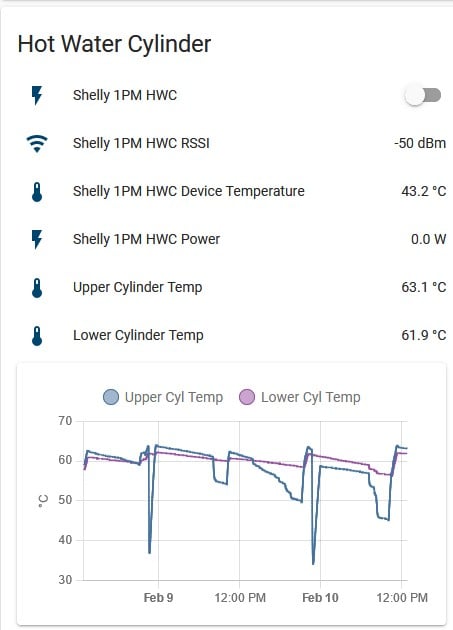
The setup is for a fairly modern 240l tank, 3kw lower element (actual 2.5kw - 2.7kw), shelly controlling power on / off, tank thermostat controlling the temp, shelly monitoring the (external) temps with 2 DS18B20 sensors. Both inserted against the tank, under the insulation at the element level and at about 1m up tank (where a second element would be)

As per the graph, the upper cylinder temp drops more than the lower cylinder temps when the hot water is used.  (They give the same readings if swapped - ie they are true either way)
Over time (when fully heated) , the upper cyl temp starts higher and then loses temp faster than the upper

Im just curious why this is? Water at top of tank is cooler? Heat doesnt rise? :)
Just trying to picture what magic is happening to understand the logic



Create new topic
nickb800
2735 posts

Uber Geek
+1 received by user: 829

Trusted

  #2864735 10-Feb-2022 13:25
Send private message

I mean the obvious question is - are you positive that you have the sensors around the right way?


I have a sensor (DS18B20 and 1PM) in a sensor pocket at the same height as the (lower and only) element of my 180L cylinder, and it exhibits a similar pattern to the 'upper' probe on your graph above. A 5-10min shower drops from 60C to 50C before recovering. A 30min shower drops it down to 25-30C, which I think correlates to using 60-80% of hot water. 


SpookyAwol

639 posts

Ultimate Geek
+1 received by user: 54


  #2864749 10-Feb-2022 13:46
Send private message

I was going to say 100% yes they are the right way, but before answering, I checked. No 😂

I reinstalled it recently and double checked - so in my mind they were correct. Turns out I should have triple checked dammit 🤡


SpookyAwol

639 posts

Ultimate Geek
+1 received by user: 54


  #2864755 10-Feb-2022 13:54
Send private message

I guess the same question exists in reverse, but makes more sense now?

The bottom of the tank can be colder than the top of the tank due to heat rising. It just means there is a slow mixing of temperature in the water?


nickb800
2735 posts

Uber Geek
+1 received by user: 829

Trusted

  #2864781 10-Feb-2022 14:50
Send private message

Ockham's razor right?


Yes it seems mixing is quite slow within a hot water cylinder - can be drawing full temp water from the top while the bottom of the cylinder is at cold tap temperature - just convection really. 


SpookyAwol

639 posts

Ultimate Geek
+1 received by user: 54


  #2879740 6-Mar-2022 14:35
Send private message

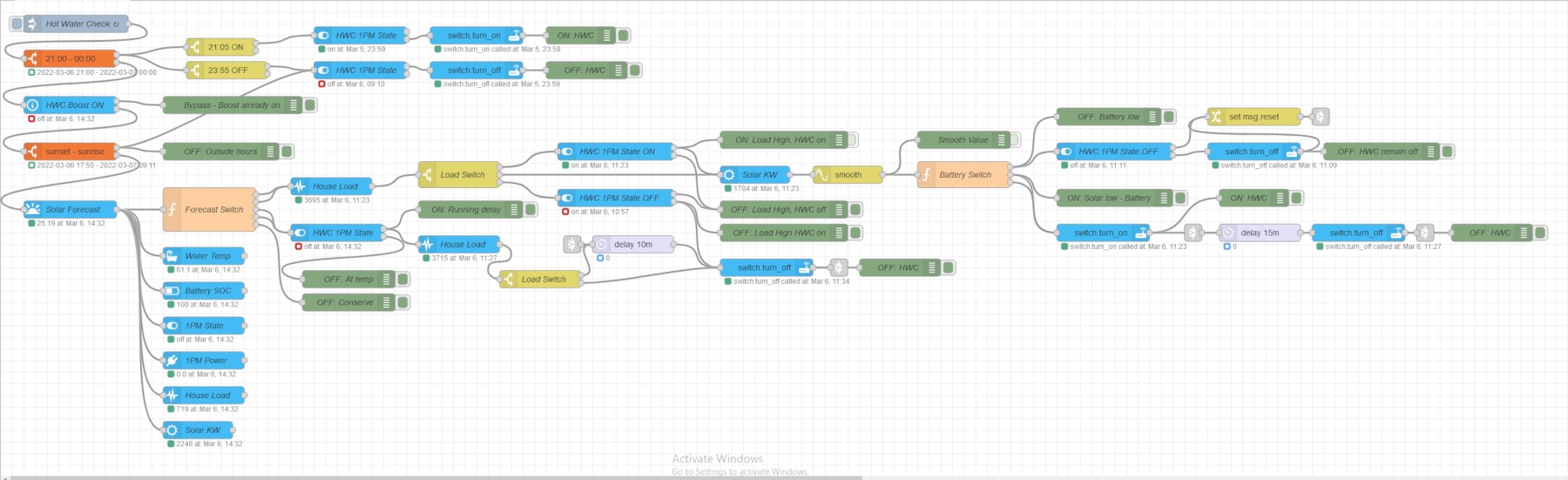
And then when you get bored, you play with Node Red.... 😁


SomeoneSomewhere
1882 posts

Uber Geek
+1 received by user: 1086

Lifetime subscriber

  #2879885 6-Mar-2022 17:17
Send private message

My understanding is that hot water cylinders intentionally discourage mixing. Ideally, the top part of the tank remains full of ~65C water and the lower part fills with ~15C as the water is drawn off. This means you get full temperature water until the tank is 'empty', rather than the temperature decreasing to e.g. 35C, at which point there would still be energy in the tank but it wouldn't be usable.


That looks much easier to deal with than the Schneider Zelio I'm running...


Create new topic


Geekzone Live »

Try automatic live updates from Geekzone directly in your browser, without refreshing the page, with Geekzone Live now.


Are you subscribed to our RSS feed? You can download the latest headlines and summaries from our stories directly to your computer or smartphone by using a feed reader.