Geekzone: technology news, blogs, forums
Guest
Welcome Guest.
You haven't logged in yet. If you don't have an account you can register now.
View this topic in a long page with up to 500 replies per page Create new topic
1 | ... | 7 | 8 | 9 | 10 | 11 | 12 
SomeoneSomewhere
1895 posts

Uber Geek
+1 received by user: 1097

Lifetime subscriber

  #3483753 24-Apr-2026 15:22
Send private message quote this post

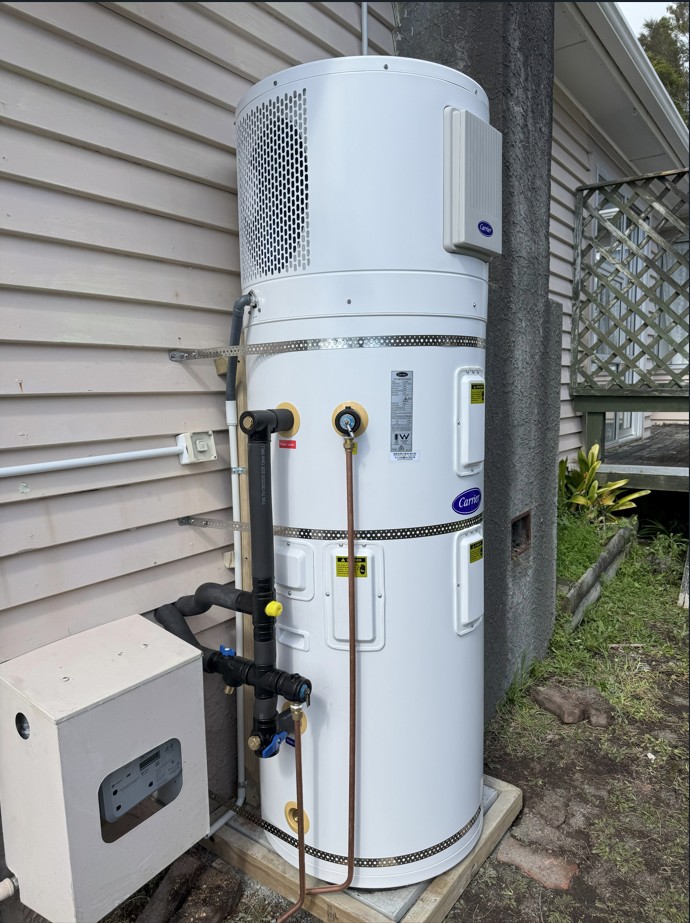
I'm surprised it wasn't installed rotated 180 degrees. Surely that would have cut the piping length (to the wall outlets) to about a third, and not affected the airflow. 


Agreed on insulating TPR valve and about the first metre of drain pipe from it. Double-insulating the first half-metre of the other pipes might be worth it, as well as the cold water piping at the inlet and the tempering valve.


Kickinbac
477 posts

Ultimate Geek
+1 received by user: 101


  #3483768 24-Apr-2026 16:31
Send private message quote this post

SomeoneSomewhere:


I'm surprised it wasn't installed rotated 180 degrees. Surely that would have cut the piping length (to the wall outlets) to about a third, and not affected the airflow. 


Agreed on insulating TPR valve and about the first metre of drain pipe from it. Double-insulating the first half-metre of the other pipes might be worth it, as well as the cold water piping at the inlet and the tempering valve.


I initially thought the same about the orientation but there is a display panel in the upper black section facing out. 


boland
565 posts

Ultimate Geek
+1 received by user: 87


  #3483775 24-Apr-2026 16:43
Send private message quote this post

Thanks all. It's all copper indeed. 


The hot water outlet pipe is hot when I feel the bare copper. The insulation around it does not feel warm at all though, so that's doing its job. I could double insulate it of course yes, and add extra insulation like suggested.


Isn't it their responsibility though to add extra insulation, if it's losing too much heat? 


They did say it shouldn't lose ~11c in 24 hours, but at the same time I'm not 100% convinced that reading that single temp sensor is enough.


SomeoneSomewhere
1895 posts

Uber Geek
+1 received by user: 1097

Lifetime subscriber

  #3483776 24-Apr-2026 16:46
Send private message quote this post

Ah. 


It looks like the controller can be removed and installed indoors, but that's not always ideal. Sometimes similar equipment is built so it can be reassembled with the pocket on the other side, but I've no idea if that applies here.


SomeoneSomewhere
1895 posts

Uber Geek
+1 received by user: 1097

Lifetime subscriber

  #3483777 24-Apr-2026 16:49
Send private message quote this post

Regarding insulation, one sensor isn't going to be that useful. It looks like the controller has an energy metering function so the ideal would be to go away for ~3 days and check how much energy was used in that time. 


It's normal for the piping in the insulation to be warm; that means the insulation is doing its job. 


boland
565 posts

Ultimate Geek
+1 received by user: 87


  #3483793 24-Apr-2026 17:50
Send private message quote this post

SomeoneSomewhere:


Regarding insulation, one sensor isn't going to be that useful. It looks like the controller has an energy metering function so the ideal would be to go away for ~3 days and check how much energy was used in that time. 


It's normal for the piping in the insulation to be warm; that means the insulation is doing its job. 


The outdoor controller does not have temperature monitoring as far as I can tell. The app doesn't show it either. However, I have integrated it with Home Assistant and a certain property comes through that seems to be the total number of kwh; it's called power_consumption. In about 6 weeks it is at 50, which would be ~1.2 kwh / day. 


SomeoneSomewhere
1895 posts

Uber Geek
+1 received by user: 1097

Lifetime subscriber

  #3483794 24-Apr-2026 17:53
Send private message quote this post

You want the power consumption over a period with no water usage, as otherwise it's just going to be dwarfed by showers etc.


Input power consumption is going to be electricity consumption, not heat output. 


Check the manual for the controller from the Gree website; it seemed to have a bunch of data options in it. 


Kickinbac
477 posts

Ultimate Geek
+1 received by user: 101


  #3483806 24-Apr-2026 19:29
Send private message quote this post

A way to get an idea of the standing loss would be to heat the cylinder to say 60 degrees. Turn off the power, measure water temp at tap, close valves, wait for say 12 or 24 hours and then measure the temp at the tap again. Consider monitoring/ logging the ambient air temperature too. The higher the temperature differential between the cylinder and the air, the higher the standing heat loss. 
Also bear in mind that your HWC being new should meet MEPS so cylinder insulation will be good.
This is partially a reason I prefer split systems and having the cylinder inside, any standing losses heat my home. I live in Tauranga where it’s not particularly cold! 😂


SomeoneSomewhere
1895 posts

Uber Geek
+1 received by user: 1097

Lifetime subscriber

  #3483828 24-Apr-2026 21:32
Send private message quote this post

The issue with measuring the temperature at a single point is that things like tank stratification can change the temperature at individual locations even if no heat leaves the cylinder - just a redistribution of where the heat is within the cylinder.


The heat patterns within a recently heated tank and a coasting tank are not necessarily the same. 


Better to measure the energy to maintain the tank at a constant condition, and preferably between e.g. two end-of-heating-cycles.


(imagine a cylinder heated from the outside in, with the temperature sensor also in the water near the outside. While the tank is heating, the water at the outside edge will be the warmest part of the tank with the core temperature lagging behind. Once the heating stops and the tank begins losing temperature, the core will maintain temperature (initially even rising) while the edge loses temperature first to the core and also to the exterior, becoming colder than the core.)


Kickinbac
477 posts

Ultimate Geek
+1 received by user: 101


  #3483835 24-Apr-2026 22:23
Send private message quote this post

SomeoneSomewhere:


The issue with measuring the temperature at a single point is that things like tank stratification can change the temperature at individual locations even if no heat leaves the cylinder - just a redistribution of where the heat is within the cylinder.


The heat patterns within a recently heated tank and a coasting tank are not necessarily the same. 


Better to measure the energy to maintain the tank at a constant condition, and preferably between e.g. two end-of-heating-cycles.


(imagine a cylinder heated from the outside in, with the temperature sensor also in the water near the outside. While the tank is heating, the water at the outside edge will be the warmest part of the tank with the core temperature lagging behind. Once the heating stops and the tank begins losing temperature, the core will maintain temperature (initially even rising) while the edge loses temperature first to the core and also to the exterior, becoming colder than the core.)


Yes! I deleted the part I wrote on stratification in my previous post. Trying to not over complicate things.


The way HWHP’s put the refrigerants heat into the cylinder are different. 

My Panasonic CO2 split system has a refrigerant to water heat exchanger in the outdoor unit and pumps hot water into the cylinder near the top and draws the cool water off at the bottom. This helps with getting usable hot water quickly as CO2 heats the water to ~60 degrees in one pass and that hot water is at the top and not mixed. It works with the stratification.

Many ‘all in one’ Hot Water Heat Pumps, heat the water in the cylinder directly from the hot refrigerant in pipes that surround the cylinder heating from the outside in as you describe. There are various versions of this such as a coil in the cylinder. So the stratification effect is not as simple and I suppose the engineers designing these look for the most effective locations for a temperature sensor(s) for it to work well.


A conventional electric hot water cylinder heats at the bottom so the heated water rises to the top, they usually have curved elements and sparge pipes for the cold water inlet so the stratification isn’t disturbed too much at the top of the cylinder so there is usable hot water quicker, otherwise the cold mixes too much and there is only warm water for a long time! It can take a couple of hours or more to warm up from cold depending on how powerful the element(s) are.


SomeoneSomewhere
1895 posts

Uber Geek
+1 received by user: 1097

Lifetime subscriber

  #3483837 24-Apr-2026 23:12
Send private message quote this post

Yeah, we put in a big HWHP with a separate cylinder at a fast food restaurant some years back - 37kW capacity into a 450L tank with a little electrically-boosted 50L tank on top to guarantee hot DHW, regardless of the hot water that was used for other purposes (but maybe didn't need to be 60C). 


The point is that you can't assume that just because the discharge temperature (or any other single temperature) has reduced by 10C, the whole tank has on average cooled by 10C.


Easier to say that the tank is at X temperature now, and still at X temperature in 72 hours time, and measure the energy that went in to maintain that condition - regardless of what X is. 


boland
565 posts

Ultimate Geek
+1 received by user: 87


  #3483950 26-Apr-2026 09:42
Send private message quote this post

SomeoneSomewhere:


Check the manual for the controller from the Gree website; it seemed to have a bunch of data options in it. 


Thanks, I've followed the steps to enable it, but it doesn't seem to work. After enabling, another menu should give access; but shows 49 instead of 00 as per docs, and it doesn't let me go through.
Gree+ app also still shows there's no usage.


Has anyone with a Gree WHIO successfully enabled energy consumption monitoring?


Binson
1 post

Wannabe Geek


  #3486396 2-May-2026 07:40
Send private message quote this post

DjShadow:


Our Carrier HWP just gone in (plumber from A2W plumbing still here as I type), it's a lot bigger than how it appeared in the promotional material. Natural Gas now fully redundant and hoping Genesis will have someone over as early as tomorrow to take the meter out.


Real good timing too as we got an e-mail from Genesis yesterday indicating our line rate was going to $1.63/day and the use rate going from 16c to 24c per kW.


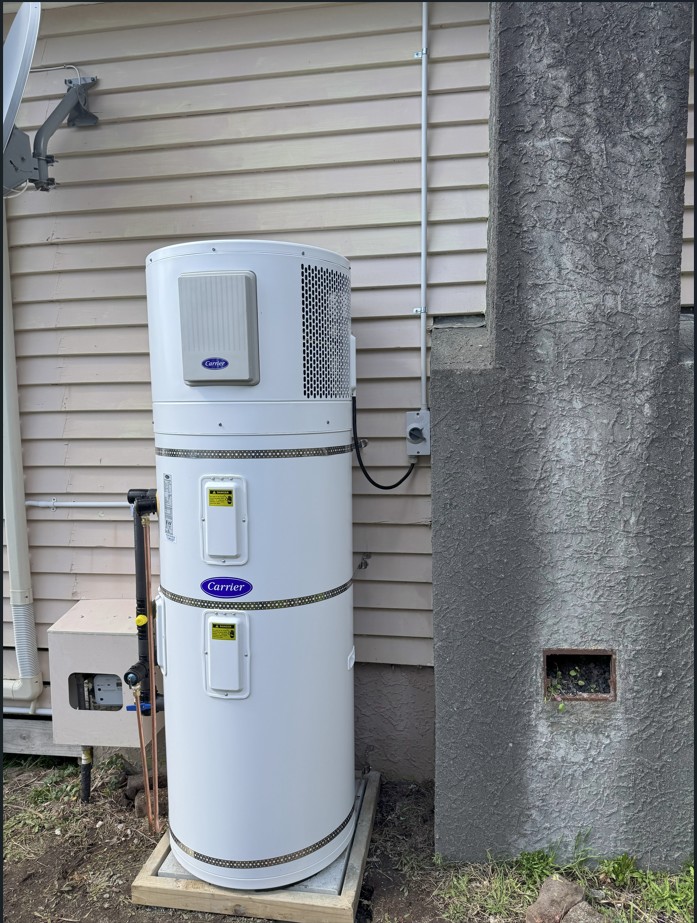
I am looking into installing a Carrier 190L heat pump water heater, but I’m working with very limited space. I plan to install it between two windows, so I need to confirm the airflow direction.


When facing the front of the unit, which side is the air intake and which is the discharge? Also, I believe there


is no grill on the top—can anyone confirm this? Knowing the exact flow will help me plan the clearances properly.


batdan
87 posts

Master Geek
+1 received by user: 10

ID Verified

  #3487275 4-May-2026 11:16
Send private message quote this post

Binson:


I am looking into installing a Carrier 190L heat pump water heater, but I’m working with very limited space. I plan to install it between two windows, so I need to confirm the airflow direction.


When facing the front of the unit, which side is the air intake and which is the discharge? Also, I believe there


is no grill on the top—can anyone confirm this? Knowing the exact flow will help me plan the clearances properly.


I have a 190L one. Air flow is from the right (in) to the left (out). Air flow is not what I would consider strong.
And top has no grill.


1 | ... | 7 | 8 | 9 | 10 | 11 | 12 
View this topic in a long page with up to 500 replies per page Create new topic


Geekzone Live »

Try automatic live updates from Geekzone directly in your browser, without refreshing the page, with Geekzone Live now.


Are you subscribed to our RSS feed? You can download the latest headlines and summaries from our stories directly to your computer or smartphone by using a feed reader.