Geekzone: technology news, blogs, forums
Guest
Welcome Guest.
You haven't logged in yet. If you don't have an account you can register now.


View this topic in a long page with up to 500 replies per page Create new topic
1 | 2 | 3 | 4 | 5 | 6 | 7 | 8 | ... | 28
RUKI
1405 posts

Uber Geek
+1 received by user: 422


  #2860810 2-Feb-2022 18:51
Send private message quote this post

Benefit of working from home with solar array on the roof and no need for a daily commute:
- can charge during the day and do not have to install all that unnecessary automated gear - i.e. to divert here or there or to reduce current or to increase current. Just plug the cable when the sun is shining and charge it.. :)


Toyota / Lexus Hybrid and EV Battery Expert Battery Test & Repair 


RunningMan
9188 posts

Uber Geek
+1 received by user: 4841


  #2860832 2-Feb-2022 19:58
Send private message quote this post

Scott3:


Always was a bit naughty (and illegal to sell) due to the rating of the unit being 200v not 230v. But this practice was expressly prohibited in 2020: https://gazette.govt.nz/notice/id/2020-au5440


Doesn't stop people trying. https://www.trademe.co.nz/a/motors/car-parts-accessories/batteries-chargers/listing/3454109983


Scott3
4177 posts

Uber Geek
+1 received by user: 2990

Trusted
Lifetime subscriber

  #2860885 2-Feb-2022 22:39
Send private message quote this post

SaltyNZ:


We had a visit from Future Energy yesterday to discuss additional heat pumps and solar, with EV charging on the side since he was here anyway and we're holding onto the Leaf at least until EVs Enhanced come out with more details on 16 Blade. Given that at for the foreseeable future there will be quite a lot of working from home for my wife and I (e.g. the new 2degrees office does not even have enough seats for 100% of staff, deliberately) a significant amount of our EV charging can be done during the day. With that in mind he not only recommends against batteries - which add a huge cost but can't store enough to touch the sides of even one EV, let alone two - but also getting a Wallbox Pulsar EVSE. Not only does it do up to 22kW charging when you need it (which as I said previously we can live without, from experience) but more importantly in this context it can do solar divert.


Solar divert means it talks to the inverter and whatever the PV is generating but the house is not drawing is shunted to the EVSE to trickle charge the car instead. That way you don't lose it by pumping to the grid and then buying it back later at a higher price. And if you need it to go from green mode to full noise you switch it in the app and it starts drawing full power immediately.


Batteries only make a contribution if you can only charge the car at night, and even then with the cost and relatively small capacity of a battery compared to the EV he feels it is still more economical to feed excess to the grid during the day and buy it back at night. Batteries currently only really worth it if power outages are frequent and long, which even out here they aren't. They'd average less than one a year, for maybe half a day, over 11 years here.


The only annoying thing is that an EVSE which can do both Type 1 and Type 2 is significantly more expensive so most likely if and when they come out to install the other stuff I'd get a second caravan plug installed outside the house so that the M3 can use the EVSE and the Leaf can keep using the 16A portable charger.


Family members have the Wallbox Pulsar. Don't think it offers solar divert. Family members do it manually, via the app.


https://support.wallbox.com/wp-content/uploads/ht_kb/2021/05/Pulsar_Datasheet_English.pdf


Regarding 22kW, to access this, you need three phase power. The single phase version is 7.2kW like most competing brands. If you do have three phase (or a planning to upgrade), 22kW ability is a selling point, otherwise it offers no advantage, two of the three phases will be unused anyway. Note that multiple phases is a bit of a chore with current solar tech (can end up exporting on one phase and importing on another).


Also note that there is a similar, but different pulsar plus, that has wifi, and can be connected to a Meter on you incoming wire to ensure the charger doesn't overload your pole fuse. Also supports DC leakage detection saving cira $400, and four bays in the circuit board.


https://support.wallbox.com/wp-content/uploads/2021/12/EN_Pulsar_Plus_Datasheet_English.pdf


On the type 1 / type 2 thing, Some brands offer cost competitive chargers with type 2 sockets, enabling you to plug in what ever kind of cord suits you at the time. Pulsar is nice, but expensive.


As an example:


https://oemaudio.co.nz/electric-vehicle-charging-products/ev-wallchargers/eo-mini-pro-2-silver-solar-package


Note a limitation of the above product is you can't connect multiple of them together and set a combined power limit.


RunningMan
9188 posts

Uber Geek
+1 received by user: 4841


  #2860926 3-Feb-2022 07:17
Send private message quote this post

Scott3: If you do have three phase (or a planning to upgrade), 22kW ability is a selling point, otherwise it offers no advantage, two of the three phases will be unused anyway.


There's many EVs with 3 phase chargers. All 3 phases are used.


cthombor
86 posts

Master Geek
+1 received by user: 13

Lifetime subscriber

  #2861461 3-Feb-2022 21:39
Send private message quote this post

SaltyNZ:


We had a visit from Future Energy yesterday to discuss additional heat pumps and solar, with EV charging on the side since he was here anyway and we're holding onto the Leaf at least until EVs Enhanced come out with more details on 16 Blade. Given that at for the foreseeable future there will be quite a lot of working from home for my wife and I (e.g. the new 2degrees office does not even have enough seats for 100% of staff, deliberately) a significant amount of our EV charging can be done during the day. With that in mind he not only recommends against batteries - which add a huge cost but can't store enough to touch the sides of even one EV, let alone two - but also getting a Wallbox Pulsar EVSE. Not only does it do up to 22kW charging when you need it (which as I said previously we can live without, from experience) but more importantly in this context it can do solar divert.


Solar divert means it talks to the inverter and whatever the PV is generating but the house is not drawing is shunted to the EVSE to trickle charge the car instead. That way you don't lose it by pumping to the grid and then buying it back later at a higher price. And if you need it to go from green mode to full noise you switch it in the app and it starts drawing full power immediately.


Batteries only make a contribution if you can only charge the car at night, and even then with the cost and relatively small capacity of a battery compared to the EV he feels it is still more economical to feed excess to the grid during the day and buy it back at night. Batteries currently only really worth it if power outages are frequent and long, which even out here they aren't. They'd average less than one a year, for maybe half a day, over 11 years here.


The only annoying thing is that an EVSE which can do both Type 1 and Type 2 is significantly more expensive so most likely if and when they come out to install the other stuff I'd get a second caravan plug installed outside the house so that the M3 can use the EVSE and the Leaf can keep using the 16A portable charger.


If you have an electric hot-water heater, then I'd suggest you install a smart-controller that'll feed it any excess power from your PV array.  But I don't know how that'd interact with the Wallbox Pulsar EVSE.   My long-term hope for home PV systems is that a bog-standard inverter would have three AC outlets: one for powering your EVSE(s), one for powering your HWC, and one for powering the rest of your household at 230 VAC.  When power is leaking from your house onto the grid, that's detectable with a wireless current-sensor; and then (depending on the time of day, the temperature of your HWC, and any over-rides you have set e.g. "charge my EV as fast as possible starting immediately, even if I have to pay peak-rate charges for electricity from the grid") my hoped-for inverter would deliver variable-voltage AC to the HWC (so that it'll heat slowly if there isn't much power available) and *maybe* even have a low-voltage (100 VAC) charging mode for your EVSE, so that it could charge at just 6A * 100 VAC = 600 W if that's all the spare power that's currently available from your household.   Another futuristic-dream: a smart-EVSE which has a smallish (say 1 kWh) battery that it cycles on (say) 5-minute intervals whenever your household is producing some excess power but not enough to AC-charge a BEV at its minimum charge rate (6A at 230VAC being 1500W -- which is more than my small rooftop array ever produces, except for a few hours on each sunny summer day when it can peak at 1800 W).  All to say: I personally wouldn't spend large on the smart-EVSEs available currently, as I'd be holding out hope for future EVSEs to be even more flexible (and even easier to program) than the currently-available ones.

And I do agree that batteries are a very expensive way to store the PV electricity your house can generate during a lightly-loaded sunny day.  Even if you have sized them optimally, and are controlling their charge/discharge optimally, I think they'd only make economic sense if you have to pay more then $0.35/kWh for electricity at the times your PV isn't generating, or if you have some really inexpensive batteries (i.e. second-life ones from a friend's clapped-out Leaf) and can trust whoever is wiring them into a homebuilt "powerwall" not to create a major domestic fire-hazard...


SaltyNZ
8867 posts

Uber Geek
+1 received by user: 9550

Trusted
2degrees
Lifetime subscriber

  #2861464 3-Feb-2022 21:52
Send private message quote this post

No, we have a pair of LPG infinity systems for hot water: we have two teenagers.


We got the quote back tonight and after running it through the software and comparing it with a year's worth of power bills they estimated roughly a third of our daily use coming from solar, payback in less than 6 years with a total saving of around $66K over 25 years from the initial $14K outlay. It helps that we have two large roofs with north aspect that are never shaded because we are on top of the hill, so they're always generating at least some power whenever the sun is up, and they can mount all the panels closer to the bottom to make cleaning easier.


That includes the EVSE plus smart controller to bleed solar excess into the car if it is plugged in rather than export to grid (with the app able to flip it over to full power - we're doing single phase so 7kW - at any time). Basically the same idea as what you suggested for hot water, but to the EV instead.


At the end of the 25 year nominal life the panels are still expected to be generating around 85% of the original output too. Quite long life these days.


So I told them yes please!


iPad Pro 11" + iPhone 15 Pro Max + 2degrees 4tw!


These comments are my own and do not represent the opinions of 2degrees.


Stream your favourite shows now on Apple TV (affiliate link).
SaltyNZ
8867 posts

Uber Geek
+1 received by user: 9550

Trusted
2degrees
Lifetime subscriber

  #2861465 3-Feb-2022 21:55
Send private message quote this post

RunningMan:


Scott3: If you do have three phase (or a planning to upgrade), 22kW ability is a selling point, otherwise it offers no advantage, two of the three phases will be unused anyway.


There's many EVs with 3 phase chargers. All 3 phases are used.


I think he's referring to the building not having three-phase, rather than the EV.


iPad Pro 11" + iPhone 15 Pro Max + 2degrees 4tw!


These comments are my own and do not represent the opinions of 2degrees.


michaelmurfy
meow
13581 posts

Uber Geek
+1 received by user: 10914

Moderator
ID Verified
Trusted
Lifetime subscriber

  #2861470 3-Feb-2022 22:17
Send private message quote this post

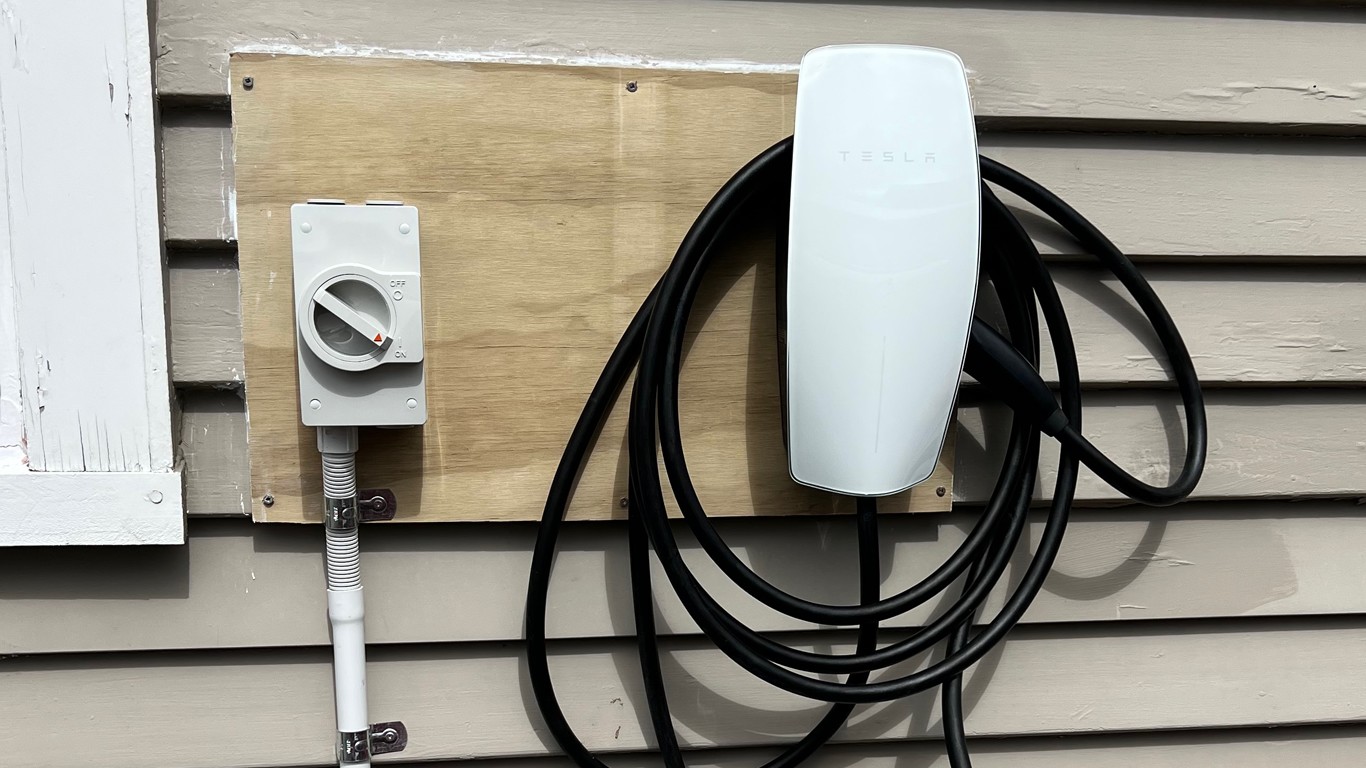
Today I just had my Tesla charger installed:


So a couple of points why this is better than just shoving in a 32a caravan plug for example:


1) It has smarts in it and on its current firmware you're able to lock out charging to your Tesla(s) only so other people can't steal power.
2) It actually isn't much more as you'd otherwise need to install a Type B RCD which adds ~$500 to an average install.
3) Looks nicer if not installed on the side of a 1950's house like in my case.


Our Sparky installed a Type A RCD and a breaker and the Tesla charger itself has a Type B RCD internally. This charger can be unlocked to work with other cars (you have the option to restrict it to Teslas only, your Teslas or unlocked for all EV's). Just an idea for an outdoor option.


Michael Murphy | https://murfy.nz
Referral Links: Quic Broadband (use R122101E7CV7Q for free setup)

Are you happy with what you get from Geekzone? Please consider supporting us by subscribing.
Opinions are my own and not the views of my employer.


RunningMan
9188 posts

Uber Geek
+1 received by user: 4841


Scott3
4177 posts

Uber Geek
+1 received by user: 2990

Trusted
Lifetime subscriber

  #2861475 3-Feb-2022 23:08
Send private message quote this post

SaltyNZ:


RunningMan:


There's many EVs with 3 phase chargers. All 3 phases are used.


I think he's referring to the building not having three-phase, rather than the EV.


Yip.


Most houses in NZ are single phase. Still useful for a car to be able to charge from three phase power, as some houses are three phase, as are most commercial / industrial sites.


Frankly, unless you already have three phase power at home, the cost of upgrading to the phase is unlikely to be worth it just for EV charging.


SomeoneSomewhere
1882 posts

Uber Geek
+1 received by user: 1086

Lifetime subscriber

  #2861487 4-Feb-2022 01:34
Send private message quote this post

cthombor:


SaltyNZ:


We had a visit from Future Energy yesterday to discuss additional heat pumps and solar, with EV charging on the side since he was here anyway and we're holding onto the Leaf at least until EVs Enhanced come out with more details on 16 Blade. Given that at for the foreseeable future there will be quite a lot of working from home for my wife and I (e.g. the new 2degrees office does not even have enough seats for 100% of staff, deliberately) a significant amount of our EV charging can be done during the day. With that in mind he not only recommends against batteries - which add a huge cost but can't store enough to touch the sides of even one EV, let alone two - but also getting a Wallbox Pulsar EVSE. Not only does it do up to 22kW charging when you need it (which as I said previously we can live without, from experience) but more importantly in this context it can do solar divert.


Solar divert means it talks to the inverter and whatever the PV is generating but the house is not drawing is shunted to the EVSE to trickle charge the car instead. That way you don't lose it by pumping to the grid and then buying it back later at a higher price. And if you need it to go from green mode to full noise you switch it in the app and it starts drawing full power immediately.


Batteries only make a contribution if you can only charge the car at night, and even then with the cost and relatively small capacity of a battery compared to the EV he feels it is still more economical to feed excess to the grid during the day and buy it back at night. Batteries currently only really worth it if power outages are frequent and long, which even out here they aren't. They'd average less than one a year, for maybe half a day, over 11 years here.


The only annoying thing is that an EVSE which can do both Type 1 and Type 2 is significantly more expensive so most likely if and when they come out to install the other stuff I'd get a second caravan plug installed outside the house so that the M3 can use the EVSE and the Leaf can keep using the 16A portable charger.


If you have an electric hot-water heater, then I'd suggest you install a smart-controller that'll feed it any excess power from your PV array.  But I don't know how that'd interact with the Wallbox Pulsar EVSE.   My long-term hope for home PV systems is that a bog-standard inverter would have three AC outlets: one for powering your EVSE(s), one for powering your HWC, and one for powering the rest of your household at 230 VAC.  When power is leaking from your house onto the grid, that's detectable with a wireless current-sensor; and then (depending on the time of day, the temperature of your HWC, and any over-rides you have set e.g. "charge my EV as fast as possible starting immediately, even if I have to pay peak-rate charges for electricity from the grid") my hoped-for inverter would deliver variable-voltage AC to the HWC (so that it'll heat slowly if there isn't much power available) and *maybe* even have a low-voltage (100 VAC) charging mode for your EVSE, so that it could charge at just 6A * 100 VAC = 600 W if that's all the spare power that's currently available from your household.   Another futuristic-dream: a smart-EVSE which has a smallish (say 1 kWh) battery that it cycles on (say) 5-minute intervals whenever your household is producing some excess power but not enough to AC-charge a BEV at its minimum charge rate (6A at 230VAC being 1500W -- which is more than my small rooftop array ever produces, except for a few hours on each sunny summer day when it can peak at 1800 W).  All to say: I personally wouldn't spend large on the smart-EVSEs available currently, as I'd be holding out hope for future EVSEs to be even more flexible (and even easier to program) than the currently-available ones.

And I do agree that batteries are a very expensive way to store the PV electricity your house can generate during a lightly-loaded sunny day.  Even if you have sized them optimally, and are controlling their charge/discharge optimally, I think they'd only make economic sense if you have to pay more then $0.35/kWh for electricity at the times your PV isn't generating, or if you have some really inexpensive batteries (i.e. second-life ones from a friend's clapped-out Leaf) and can trust whoever is wiring them into a homebuilt "powerwall" not to create a major domestic fire-hazard...


There is no need for any messy current-limiting, pulsing, or voltage converting solutions. The EVSE can tell the car the maximum current it is allowed to draw. A communicating EVSE could receive info from the meter/inverter about the current amount of export power, and adjust the charging rate to suit, simply by changing the maximum charge current it allows the car. I believe some EVSEs already use a variant of this to charge one car at high speed or 2+ cars at lower speeds from a single circuit.


I don't really like supplying variable-voltage or chopped power to hot water though; it could get messy if in five years time someone installs for example a hot-water heat pump and doesn't carefully check the supply.


Shop now for Lenovo laptops and other devices (affiliate link).
Dingbatt

6804 posts

Uber Geek
+1 received by user: 3694

Lifetime subscriber

  #2861489 4-Feb-2022 05:53
Send private message quote this post

michaelmurfy:


Today I just had my Tesla charger installed:


Are you willing to divulge how much it cost? (Even ballpark). The Tesla wallbox itself is about $900 I think.


It is interesting that it will do other brand EVs.


Beauty is in the eye of the beholder…….


“We’ve arranged a society based on science and technology, in which nobody understands anything about science technology. Carl Sagan 1996


Batman
Mad Scientist
30014 posts

Uber Geek
+1 received by user: 6217

Trusted
Lifetime subscriber

  #2861500 4-Feb-2022 07:03
Send private message quote this post

is there a 240V socket charger cable & box that can live outdoor and be safe to do so?


SaltyNZ
8867 posts

Uber Geek
+1 received by user: 9550

Trusted
2degrees
Lifetime subscriber

  #2861517 4-Feb-2022 08:11
Send private message quote this post

Batman:


is there a 240V socket charger cable & box that can live outdoor and be safe to do so?


Yes, all of them. Certainly anything that is supplied with a vehicle. Ours lived outside while the house was being rebuilt. Given it was a building site and there was mud and other hazards, and it had to go on the ground as opposed to a neat hangar or anything we cut a hole in the side of a plastic container and put it in that for extra protection. But you don't have to.


iPad Pro 11" + iPhone 15 Pro Max + 2degrees 4tw!


These comments are my own and do not represent the opinions of 2degrees.


RobDickinson
1526 posts

Uber Geek
+1 received by user: 513


  #2861523 4-Feb-2022 08:22
Send private message quote this post

They should generally be ip67 rated but the plug/tail end would need a caravan plug or something for an outdoor socket?


1 | 2 | 3 | 4 | 5 | 6 | 7 | 8 | ... | 28
View this topic in a long page with up to 500 replies per page Create new topic


Geekzone Live »

Try automatic live updates from Geekzone directly in your browser, without refreshing the page, with Geekzone Live now.


Are you subscribed to our RSS feed? You can download the latest headlines and summaries from our stories directly to your computer or smartphone by using a feed reader.