|
|
|
“We’ve arranged a society based on science and technology, in which nobody understands anything about science technology. Carl Sagan 1996
tdgeek: ... I read we will double the population by 2030, now we need 6000MW ...# 2291864 7-Aug-2019 18:55
tdgeek: ... Someone posted we will double in population over 30 years ...# 2291869 7-Aug-2019 19:12
Not quite the same. But both improbable.
Probably help the discussion to keep to more reliable estimates for population growth, such as https://www.stats.govt.nz/
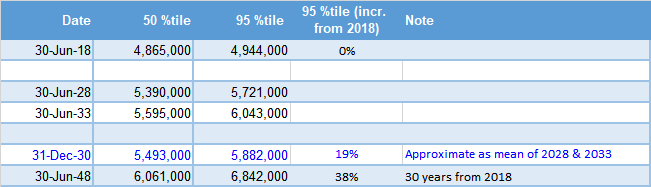
Below are selected figures from their 2016 population projections.
At the 95th percentile level, their projections for the NZ population at Dec 2030 and 30 June 2048 (~29 years from now) are 5,882,000 and 6,842,000, a long way short of doubling in either case.
And of course the median (50 %tile) figures are even lower; ~25% increase over the next 29 years, and only 13% higher by Dec 2030.
May serve as a better base for electricity demand projections.

Some minor typo edits!
tdgeek:
So from a layman, that's a lot extra to generate. Hydro would be limited? Wind is a good idea. What about storage, as lake storage isn't huge.
Energy supply is like oil... there is plenty available, but it's scattered and in the wrong places. But, as the price rises, more sources become economically viable. And price depends on demand... more demand will result in higher prices, which will result in (a) more sources being exploited, and (b) more efficient use by consumers.
If existing sources (hydro, wind) can't meet the demand, then the price will rise and new sources (waves, tidal, solar, currently uneconomic hydro and wind) will be exploited.
frankv:
tdgeek:
So from a layman, that's a lot extra to generate. Hydro would be limited? Wind is a good idea. What about storage, as lake storage isn't huge.
Energy supply is like oil... there is plenty available, but it's scattered and in the wrong places. But, as the price rises, more sources become economically viable. And price depends on demand... more demand will result in higher prices, which will result in (a) more sources being exploited, and (b) more efficient use by consumers.
If existing sources (hydro, wind) can't meet the demand, then the price will rise and new sources (waves, tidal, solar, currently uneconomic hydro and wind) will be exploited.
Correct. As its all privatised, timings of additions will be based on profit not need, there will be a lag
DS248:
Below are selected figures from their 2016 population projections.
At the 95th percentile level, their projections for the NZ population at Dec 2030 and 30 June 2048 (~29 years from now) are 5,882,000 and 6,842,000, a long way short of doubling in either case.
Yes, my "it will take 30 years to double" was a trivial extrapolation based on the 2018 growth rate of 2.1% in response to a "but what if the population doubled!?" query. It was in no way meant to be a realistic guess as to where the population would actually be in 30 years, merely "worst case the population would need 30 years to double". Of course only a couple of years previous to that the growth rate was 0.5% which is probably still higher than the realistic long term average.
iPad Pro 11" + iPhone 15 Pro Max + 2degrees 4tw!
These comments are my own and do not represent the opinions of 2degrees.
SaltyNZ:
DS248:
Below are selected figures from their 2016 population projections.
At the 95th percentile level, their projections for the NZ population at Dec 2030 and 30 June 2048 (~29 years from now) are 5,882,000 and 6,842,000, a long way short of doubling in either case.
Yes, my "it will take 30 years to double" was a trivial extrapolation based on the 2018 growth rate of 2.1% in response to a "but what if the population doubled!?" query. It was in no way meant to be a realistic guess as to where the population would actually be in 30 years, merely "worst case the population would need 30 years to double". Of course only a couple of years previous to that the growth rate was 0.5% which is probably still higher than the realistic long term average.
That's how I took your comment. I dunno why the knives come out to discredit it. My whole point is summarised that all of this is in the unknown future. EV numbers, other EV numbers (buses light rail), population change, generation infrastructure. Someone posted that we need an extra 3000 odd. MW, we have just over that consented. Great. The Govt now says we need an extra 6000MW, so there are a lot of challenges and unknowns. I see that as a concern, others see it as no problem it will all be fine.
tdgeek:
I see that as a concern, others see it as no problem it will all be fine.
Well, it's both. It is a concern, but I think it is one the industry will stay on top of.
iPad Pro 11" + iPhone 15 Pro Max + 2degrees 4tw!
These comments are my own and do not represent the opinions of 2degrees.
SaltyNZ:
tdgeek:
I see that as a concern, others see it as no problem it will all be fine.
Well, it's both. It is a concern, but I think it is one the industry will stay on top of.
Perhaps. In the past, it was only ever about gradual population growth, this time round its about a big change in usage. If generation was nationalised, less concerns, but as its private enterprise, its about waiting till its a money maker
tdgeek:
frankv:
tdgeek:
So from a layman, that's a lot extra to generate. Hydro would be limited? Wind is a good idea. What about storage, as lake storage isn't huge.
Energy supply is like oil... there is plenty available, but it's scattered and in the wrong places. But, as the price rises, more sources become economically viable. And price depends on demand... more demand will result in higher prices, which will result in (a) more sources being exploited, and (b) more efficient use by consumers.
If existing sources (hydro, wind) can't meet the demand, then the price will rise and new sources (waves, tidal, solar, currently uneconomic hydro and wind) will be exploited.
Correct. As its all privatised, timings of additions will be based on profit not need, there will be a lag
It's not totally privatised. The Govt owns 51% shares in Meridian, Genesis, and Mercury.
Privatisation and the profit motive doesn't necessarily mean a lag... if a company can foresee future profits, it will invest. Hence for example Tesla entering into the car market *before* there was significant demand for EVs; they've only just begun to make a profit.
frankv:
Hence for example Tesla entering into the car market *before* there was significant demand for EVs; they've only just begun to make a profit.
Not quite yet ;)
Looking to buy a Tesla? Use my referral link and we both get credits
frankv:
tdgeek:
frankv:
tdgeek:
So from a layman, that's a lot extra to generate. Hydro would be limited? Wind is a good idea. What about storage, as lake storage isn't huge.
Energy supply is like oil... there is plenty available, but it's scattered and in the wrong places. But, as the price rises, more sources become economically viable. And price depends on demand... more demand will result in higher prices, which will result in (a) more sources being exploited, and (b) more efficient use by consumers.
If existing sources (hydro, wind) can't meet the demand, then the price will rise and new sources (waves, tidal, solar, currently uneconomic hydro and wind) will be exploited.
Correct. As its all privatised, timings of additions will be based on profit not need, there will be a lag
It's not totally privatised. The Govt owns 51% shares in Meridian, Genesis, and Mercury.
Privatisation and the profit motive doesn't necessarily mean a lag... if a company can foresee future profits, it will invest. Hence for example Tesla entering into the car market *before* there was significant demand for EVs; they've only just begun to make a profit.
Ok
Tesla is like any new business that starts from scratch. Invests, makes losses, makes a profit. I dont think that's a comparison to an existing power generator. You said earlier, demand will increase prices, that will encourage investment. Now you feel they will invest now, based on foreseen future profits?
On to a different subject, a common claim that seems to pop up in the comments of news articles about EVs is that they're dirtier than a ICE vehicle. I came across this well written article on why that's not true.
Looking to buy a Tesla? Use my referral link and we both get credits
The claim that the lifecycle of an electric car produces more greenhouse gases than an internal combustion car is entirely the result of 50% carefully cherrypicked spin doctoring combined with 50% outright falsehoods.
- if you buy an electric car with the biggest battery that requires the most manufacturing resources
- if you drive your electric car in the least efficient way
- if you drive your electric car in the worst climatic conditions for battery life
- if you charge it only with electricity generated entirely by oil or coal
- if you do not properly recycle the battery at the end of its life
- if you choose for your comparison the biggest-battery electric car against the smallest, lightest, compact internal combustion car
...The answer is still no.
Even this worst case scenario substantially beats even the most efficient internal combustion cars. There's still one thing we have to do to before our electric car will actually be worse, and that's crash it and remove it from service before it's been driven anywhere. Because as soon as you and your internal combustion counterpart start driving, the scale tips the other direction.
tdgeek:
frankv:
It's not totally privatised. The Govt owns 51% shares in Meridian, Genesis, and Mercury.
Privatisation and the profit motive doesn't necessarily mean a lag... if a company can foresee future profits, it will invest. Hence for example Tesla entering into the car market *before* there was significant demand for EVs; they've only just begun to make a profit.
Ok
Tesla is like any new business that starts from scratch. Invests, makes losses, makes a profit. I dont think that's a comparison to an existing power generator. You said earlier, demand will increase prices, that will encourage investment. Now you feel they will invest now, based on foreseen future profits?
Yes. If they believe the forecasts for demand and price.
For example, the major car manufacturers have now all? jumped onto the EV bandwagon. They expect to make profits from EVs in (I guess) 5 years, so they're now investing seriously in EVs now.
When there is a credible forecast that says NZ will be short of electricity in (say) 5 years, NZ electricity generating companies will look at their development plans and see what they can get up and running in 5 years, and what price is needed for those to be economic. Hence all the consented but not yet started projects... they've looked at those sites, figured out that some time it will be economic to generate power there, and done the regulatory stuff to get that out of the way now, so when circumstances change they'll be ready to go ahead.
Yes, there may be a lag between demand and supply, especially when circumstances change that weren't included in the forecasts. But it's not necessarily true. And the converse may happen, where supply exceeds demand. I expect that there's a number of oil exploration and drilling projects which will fall into this category.
|
|
|