Geekzone: technology news, blogs, forums
Guest
Welcome Guest.
You haven't logged in yet. If you don't have an account you can register now.


Filter this topic showing only the reply marked as answer View this topic in a long page with up to 500 replies per page Create new topic
1 | ... | 15 | 16 | 17 | 18 | 19 | 20 | 21
frankv
5705 posts

Uber Geek
+1 received by user: 3666

Lifetime subscriber

  #2515687 1-Jul-2020 14:49
Send private message

cshwone:


Thanks for doing these graphs but I think the one you posted above is pretty meaningless. All the new cases are held at the border in effect and are a function of arrivals in the country. If we get non-border related cases then extending the graph would make sense.


Yeah, I agree. Really need to separate out the isolated cases from the rest. I'll see what I can do.


frankv
5705 posts

Uber Geek
+1 received by user: 3666

Lifetime subscriber

  #2516884 3-Jul-2020 16:34
Send private message

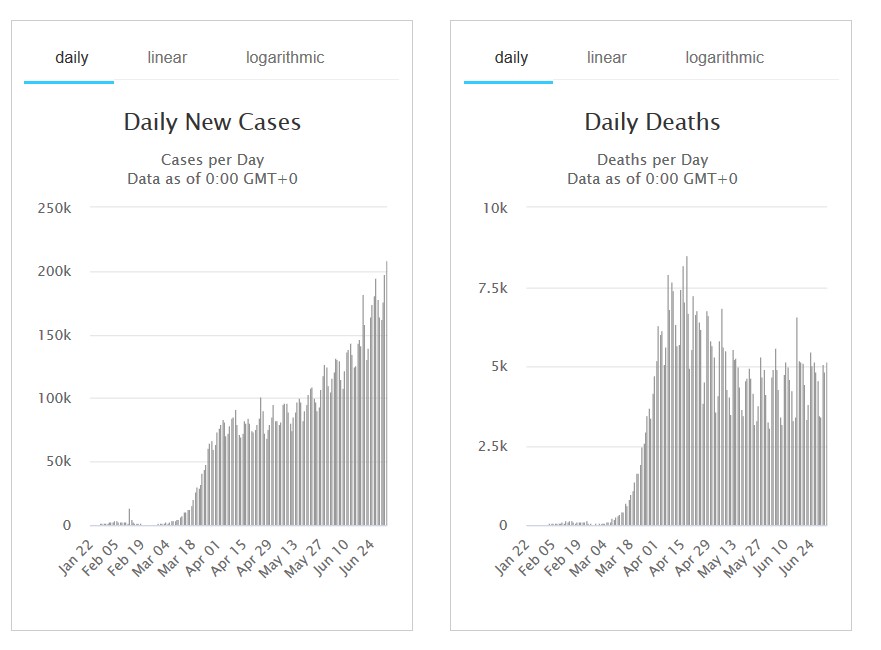
There's something interesting happening with infection rates & mortality. The graphs below are from the Worldometer (and, yes, I know worldometer is untrustworthy -- maybe someone can find some trustworthy numbers?). I'd expect that death rates would more or less mirror infection rates, except (obviously) smaller numbers and a couple of weeks later. But that doesn't appear to be the case. Death rates have been more or less constant at 3-5k per day since late April, whilst infection rates have about doubled, from about 80-90k to over 150k.


I'm wondering if the new mutation is not only 3-9 times more infectious, but also much less virulent. Hence the renewed growth in infections, but a constant death rate.


Thoughts?


mattwnz
20520 posts

Uber Geek
+1 received by user: 4797


  #2516892 3-Jul-2020 16:48
Send private message

I had noticed that too, and it could be the case. But I am wondering if it isn't partly due to a lot more testing, so a lot more  people with  asymptomatic cases getting detected.


wellygary
8813 posts

Uber Geek
+1 received by user: 5298


  #2516899 3-Jul-2020 17:08
Send private message

mattwnz:


I had noticed that too, and it could be the case. But I am wondering if it isn't partly due to a lot more testing, so a lot more  people with  asymptomatic cases getting detected.


Ditto, there is definitely a flattening/stabilising of the mortality curve.


I've seen  a number of possible explanations or it may be a combination of all of them


1) The Virus has become less lethal


Professor Matteo Bassetti, the chief of infectious diseases at San Martino General Hospital in Genoa, Italy, said the virus had changed since earlier in the spring and become much less virulent, with more patients in Italy recovering from severe symptoms.


http://www.nydailynews.com/coronavirus/ny-coronavirus-matteo-bassetti-downgrades-tiger-wild-cat-no-vaccine-20200621-cd3wj33buvc6be5u6olhaitgxe-story.html


2) Treatments have improved,  Dexamethasone etc,


3) Curve Flattening has resulted in Hospitals and ICU not being overrun as they were in the initial outbreaks....


frankv
5705 posts

Uber Geek
+1 received by user: 3666

Lifetime subscriber

  #2516997 3-Jul-2020 20:06
Send private message

Yeah, I get all of that. But this is such a radical change, where effectively the CFR has halved. And many of the new infections are in poor countries like Brazil and Peru where, in my preconceptions, the health system ought not to be able to cope.

KrazyKid
1247 posts

Uber Geek
+1 received by user: 616


  #2517050 3-Jul-2020 20:54
Send private message

It could be as simple as the age of those being infected. For example a significant number of the new cases in the USA under under 35 years old. The death rate is very low for younger people. And it's really significant for the over 60.

This would mean that since the poorer countries have a higher proportion of young people so their death rate overall it's going to be low.


Shop now for Dyson appliances (affiliate link).
clinty
1201 posts

Uber Geek
+1 received by user: 402

Lifetime subscriber

  #2517076 3-Jul-2020 22:51
Send private message

Some good seven day rolling average charts for countries, showing the recent upticks on those that came out of lockdown early

https://edition.cnn.com/2020/07/03/health/coronavirus-lockdown-lifting-deadly-charts-intl/index.html

Clint

DS248

1702 posts

Uber Geek
+1 received by user: 771

Lifetime subscriber

  #2522581 14-Jul-2020 09:40
Send private message

Further evidence that immunity to SARS-CoV-2 may be relatively short-lived (medrxiv preprint)


https://www.medrxiv.org/content/10.1101/2020.07.09.20148429v1.full.pdf 


clinty
1201 posts

Uber Geek
+1 received by user: 402

Lifetime subscriber

  #2564216 15-Sep-2020 09:57
Send private message

Posted this in the main Covid thread, but thought it should be here as well :)


A good write up in the conversation on what people are getting wrong about Covid 19 Statistics


now-everyones-a-statistician-heres-what-armchair-covid-experts-are-getting-wrong


If we don’t analyse statistics for a living, it’s easy to be taken in by misinformation about COVID-19 statistics on social media, especially if we don’t have the right context.


For instance, we may cherry pick statistics supporting our viewpoint and ignore statistics showing we are wrong. We also still need to correctly interpret these statistics.


It’s easy for us to share this misinformation. Many of these statistics are also interrelated, so misunderstandings can quickly multiply.


Here’s how we can avoid five common errors, and impress friends and family by getting the statistics right.


1. It’s the infection rate that’s scary, not the death rate


2. Exponential growth and misleading graphs


3. Not all infections are cases


4. We can’t compare deaths with cases from the same date


5. Yes, the data are messy, incomplete and may change


The article goes into each in more depth


Clint


wellygary
8813 posts

Uber Geek
+1 received by user: 5298


  #2564235 15-Sep-2020 10:11
Send private message

clinty:


Posted this in the main Covid thread, but thought it should be here as well :)


A good write up in the conversation on what people are getting wrong about Covid 19 Statistics


now-everyones-a-statistician-heres-what-armchair-covid-experts-are-getting-wrong


If we don’t analyse statistics for a living, it’s easy to be taken in by misinformation about COVID-19 statistics on social media, especially if we don’t have the right context.


For instance, we may cherry pick statistics supporting our viewpoint and ignore statistics showing we are wrong. We also still need to correctly interpret these statistics.


It’s easy for us to share this misinformation. Many of these statistics are also interrelated, so misunderstandings can quickly multiply.


Here’s how we can avoid five common errors, and impress friends and family by getting the statistics right.


1. It’s the infection rate that’s scary, not the death rate


2. Exponential growth and misleading graphs


3. Not all infections are cases


4. We can’t compare deaths with cases from the same date


5. Yes, the data are messy, incomplete and may change


The article goes into each in more depth


Clint


The death rate is a work in progress, and basically you wont really know how deadly it is (was) until the outbeak is over until you undertake large same serological testing to actually determine the infection rate... and then decide what death statistics to use...


As an aside, there are  articles appearing that postulate the severity of Virus symptoms could be linked to the size of the viral load in your original infection .... and if proven    could mean that distancing and masking might be very effective in bringing the global outbreak under control


DS248

1702 posts

Uber Geek
+1 received by user: 771

Lifetime subscriber

  #2565526 15-Sep-2020 18:58
Send private message

wellygary:


...


As an aside, there are  articles appearing that postulate the severity of Virus symptoms could be linked to the size of the viral load in your original infection .... and if proven    could mean that distancing and masking might be very effective in bringing the global outbreak under control


Viral load has been recognised as a factor from (almost?) the outset (probably applies to most viral infections?).  Hence the deaths of healthy young medics, including the one of the initial whistle blowers in Wuhan.  Also the reason for the 'within 2 m for 15 mins rule', though that always seemed optimistic to me.


But yes, the significance of viral load is in part why masks and distancing is important.


Want to support Geekzone and browse the site without the ads? Subscribe to Geekzone now (monthly, annual and lifetime options).
frankv
5705 posts

Uber Geek
+1 received by user: 3666

Lifetime subscriber

  #2592467 27-Oct-2020 15:55
Send private message

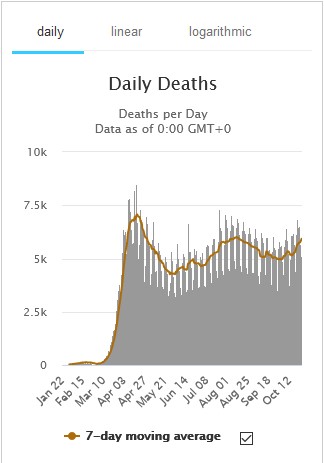
Something that just struck me... there is a weekly cycle to the covid-19 death numbers. Below graph is for the whole world, ex world-o-meter.


I can understand a weekly fluctuation in testing, and therefore in number of cases. But I wouldn't expect fluctuating test numbers to have a big effect on deaths. I'd expect the date of death, being a fairly well-defined and significant change of state, to be reported accurately. So why is there such a big (25-30%?) weekly variation in deaths?


Looking at India (as just one specific example), it appears that one is less likely to die of covid there on a Monday or Tuesday, and more likely on a Wednesday, than other days of the week.


neb

neb
11294 posts

Uber Geek
+1 received by user: 10018

Trusted
Lifetime subscriber

  #2592471 27-Oct-2020 16:00
Send private message

I can understand a weekly fluctuation in testing, and therefore in number of cases. But I wouldn't expect fluctuating test numbers to have a big effect on deaths. I'd expect the date of death, being a fairly well-defined and significant change of state, to be reported accurately. So why is there such a big (25-30%?) weekly variation in deaths?


That was discussed some time ago in terms of the figures for China, it's how deaths are reported, you get a lag over the weekend and then things catch up at the start of the working week, with typically another peak on Friday as people try and clear their workload.  So it's an artefact of the way the reporting is done, not of actual deaths.


Hammerer
2480 posts

Uber Geek
+1 received by user: 802

Lifetime subscriber

  #2592473 27-Oct-2020 16:06
Send private message

The reported data is very imperfect and comes from many different sources. Many of the sources of deaths don't provide date of death so the fluctuations are due to when the reports are made.


You need to read Learn more about Worldometer's COVID-19 data to see all the issues with the data.


Edited to insert omitted word


Tinkerisk
4800 posts

Uber Geek
+1 received by user: 3660


  #2592982 29-Oct-2020 01:01
Send private message

404 new infections on a single day now in our 1.8 Mio. city here. Luckily no deaths since one month now. Next lockdown of any kind ahead.


  • Qui nihil scit, omnia credere debet.
  • Firewalls do NOT stop dragons.
  • In effect we have everything to hide from someone, and no idea who someone is.

1 | ... | 15 | 16 | 17 | 18 | 19 | 20 | 21
Filter this topic showing only the reply marked as answer View this topic in a long page with up to 500 replies per page Create new topic


Geekzone Live »

Try automatic live updates from Geekzone directly in your browser, without refreshing the page, with Geekzone Live now.


Are you subscribed to our RSS feed? You can download the latest headlines and summaries from our stories directly to your computer or smartphone by using a feed reader.