
Geekzone: technology news, blogs, forums
Guest
Welcome Guest.
You haven't logged in yet. If you don't have an account you can register now.


View this topic in a long page with up to 500 replies per page Create new topic
1 | 2 | 3 

neb

neb

11294 posts

Uber Geek
+1 received by user: 10018

Trusted
Lifetime subscriber

  #3361406 6-Apr-2025 19:56
Send private message

tweake:


i wondered about that but a lot of rinnai tanks are setup like that with tpr on the side as they only have a single top outlet. personally i prefer it on top as its easier to bleed the air out of it.


I'm not sure the previous tank even had a TPR, just a T-junction where the hot water came out the top of the HWC, feed to the house at the left, vent straight up.  If there was something it was further up the line where you couldn't see it.


tweake
2648 posts

Uber Geek
+1 received by user: 1139


  #3361467 6-Apr-2025 21:06
Send private message

neb:


tweake:


i wondered about that but a lot of rinnai tanks are setup like that with tpr on the side as they only have a single top outlet. personally i prefer it on top as its easier to bleed the air out of it.


I'm not sure the previous tank even had a TPR, just a T-junction where the hot water came out the top of the HWC, feed to the house at the left, vent straight up.  If there was something it was further up the line where you couldn't see it.


the vent straight up is the "tpr". no pressure relief valve because the tank is open at the top of the vent. typical low pressure.


neb

neb

11294 posts

Uber Geek
+1 received by user: 10018

Trusted
Lifetime subscriber

  #3361750 7-Apr-2025 15:12
Send private message

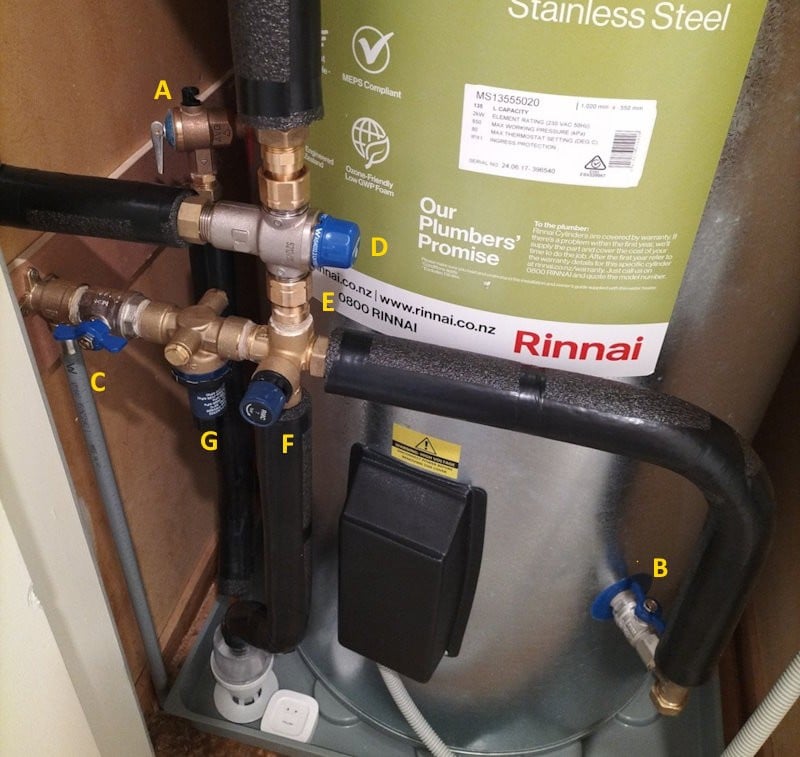
I'm in the process of lagging the pipes and left with some mystery components where it'd be good to know whether I can insulate over them, i.e. whether they need to be accessible:


Of the known ones A = TPR, B = cold water shutoff, C = hot water shutoff, D = a plastic cap as far as I can see to cover up one leg of a 4-way junction?, E = something that's presumably there purely for support otherwise it'd be connecting the cold input to the hot output?, F = cold water expansion valve labelled "RMC 7 bar", G = pressure reducing valve, can't quite read the label because it's blocked by the lagging but there's a small kPA value next to a much larger kPA value.


The expansion valve in particular looks like it's adjustable, does that need to be accessible or can I cover it with insulation?  I assume the connecting leg E, plastic-capped part D, and pressure reducing value G can all be lagged?


SomeoneSomewhere
1882 posts

Uber Geek
+1 received by user: 1086

Lifetime subscriber

  #3361766 7-Apr-2025 16:16
Send private message

D is your tempering valve; it mixes in the necessary amount of cold to achieve the selected tap water temperature; now typically 50C. 


E is probably a one-way valve. 


Common practice is to lag all the way around the valve, leaving a pocket so you can reach in and adjust or operate it.


neb

neb

11294 posts

Uber Geek
+1 received by user: 10018

Trusted
Lifetime subscriber

  #3361772 7-Apr-2025 16:33
Send private message

Ah, OK, thanks!  Now it makes sense.


I'll lag as much as possible then, the main remaining heat loss location ATM is the TPR valve and the already-lagged hot water pipe coming from the top of the cylinder.  I'll post thermal images when I'm done for anyone else doing this, the heat-loss locations aren't necessarily the expected ones.  In particular I was surprised at the heat loss through the already-insulated hot water outlet area.


tweake
2648 posts

Uber Geek
+1 received by user: 1139


  #3361781 7-Apr-2025 17:12
Send private message

E is a union.


you can cover everything expect the knobs and lever on the tpr. you may want to leave the bottom of the T at the cold water inlet, thats probably the drain point. if you need to drain the tank you will undo that end.


1 | 2 | 3 
View this topic in a long page with up to 500 replies per page Create new topic


Geekzone Live »

Try automatic live updates from Geekzone directly in your browser, without refreshing the page, with Geekzone Live now.


Are you subscribed to our RSS feed? You can download the latest headlines and summaries from our stories directly to your computer or smartphone by using a feed reader.