Geekzone: technology news, blogs, forums
Guest
Welcome Guest.
You haven't logged in yet. If you don't have an account you can register now.


OldGeek

989 posts

Ultimate Geek
+1 received by user: 409

ID Verified
Lifetime subscriber

#316124 18-Sep-2024 14:41
Send private message

According to this article : Charging Electric Cars Are Wasting More Power Than You Think (dagens.com) a considerable amount of electricity never makes it the an EV because of power losses in the process of converting AC from the mains power supply to DC in a BEV.  Is this correct?


-- 

OldGeek.


Quic referal code: https://account.quic.nz/refer/581402 and use this code for free setup: R581402E48MJA


Create new topic
jarledb
Webhead
3319 posts

Uber Geek
+1 received by user: 1983

Moderator
ID Verified
Trusted
Lifetime subscriber

  #3283566 18-Sep-2024 14:47
Send private message

Around 10% sounds reasonable.


You really shouldn't look at how much energy is wasted when it comes to ICE cars if that worries you.


Jarle Dahl Bergersen | Referral Links: Want $50 off when you join Octopus Energy? Use this referral code
Are you happy with what you get from Geekzone? Please consider supporting us by making a donation or subscribing.


Scott3
4177 posts

Uber Geek
+1 received by user: 2990

Trusted
Lifetime subscriber

  #3283569 18-Sep-2024 15:03
Send private message

WLTP published efficiency (kWh /100km or Wh/km) is based on recharged electric energy from the mains per electric range, so already includes this loss.

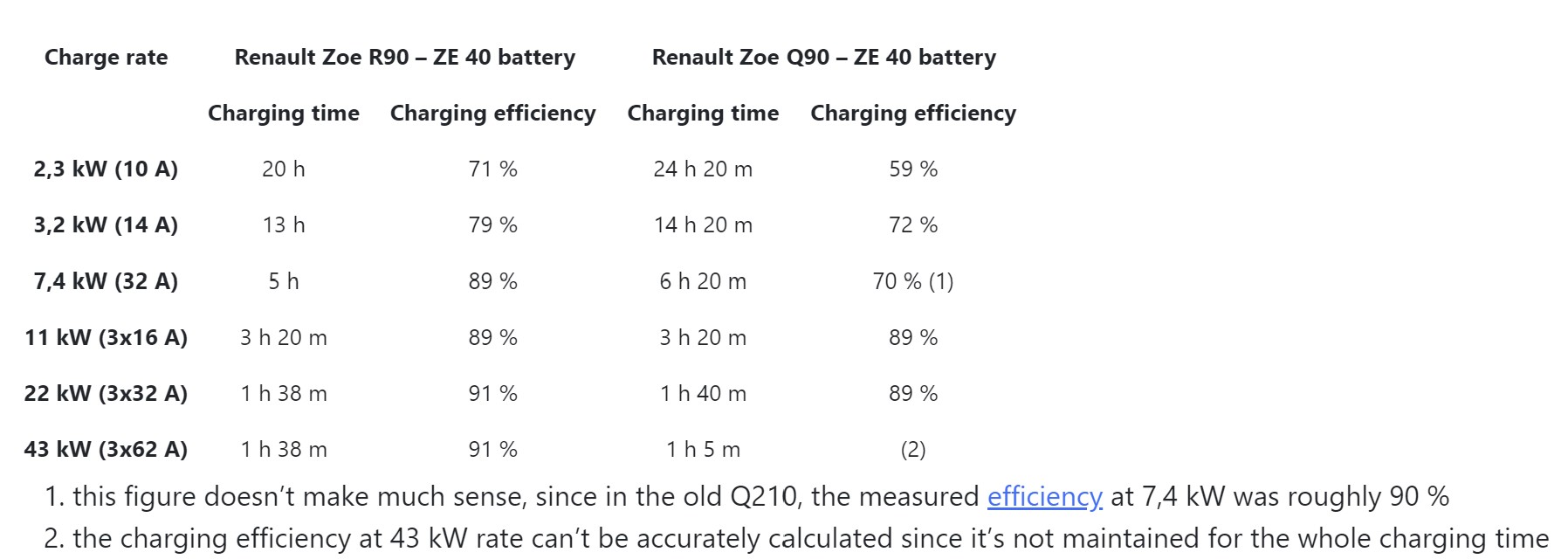
The original shape Renault Zoe (especially the Q90 variant which supports 43kW AC Charging) is well known poster child for inefficient charging. It has a cleaver charger which pulled double duty with some drivelines components to deliver a wide range of fast charging options. (R90 variant supported 22 kW AC charging & Q90 43kW AC charging). No DC charging on the original shape Zoe, as they were backing fairly quick AC charging. Subsequently the market has spoken, and high power AC charging is largely out in favor of DC, so the new shape Zoe (not sold in NZ as it didn't get a good enough crash rating to qualify for our rebate) has a DC charge port.

As you can see below the charging efficiency can be as low as 69% on a 10A feed (I guess it is even worse at 8A). This is getting to a point where it is not only wasteful, but also significantly increases charging time. 


Most (all?) other EV's have dedicated chargers, not pulling double duty with the driveline so are a lot more efficient.


I would have expected 90 - 95%


Can't find the source document for that article. I wonder if they charged the cars really slowly (say 10 A single phase)? There is a whole bunch of stuff that is on during charging (cars computer, coolant pump etc), so as a general rule AC charging a EV closer to it's max rate is more efficient.


mkissin
402 posts

Ultimate Geek
+1 received by user: 391

ID Verified
Lifetime subscriber

  #3283570 18-Sep-2024 15:04
Send private message

The conclusion of that article is a total non-sequitur. Charger inefficiency has nothing to do with how far you'll go on a charge, as by that point the charge is in your battery. It does affect how much that charge costs you.


The entire thing is also way more complicated than that article makes out. Charge rates, temperature and a number of other things affect the charge efficiency.


But also, yes, well-to-wheel an EV will always come out far beyond an ICE.


mkissin
402 posts

Ultimate Geek
+1 received by user: 391

ID Verified
Lifetime subscriber

  #3283571 18-Sep-2024 15:16
Send private message

Scott3:


I would have expected 90 - 95%


The problem here is that a more efficient charger is (generally) more expensive, and that additional cost is in the purchase price of the vehicle.


The manufacturer can reduce the vehicle cost by making a crappier charger, but then causing the purchaser to incur higher ongoing costs. Those higher ongoing costs are still pretty marginal though, in the grand scheme of things.


Jase2985
13739 posts

Uber Geek
+1 received by user: 6220

ID Verified
Lifetime subscriber

  #3283577 18-Sep-2024 15:33
Send private message

jarledb:


Around 10% sounds reasonable.


You really shouldn't look at how much energy is wasted when it comes to ICE cars if that worries you.


haha yep. 30-40% efficient


From power in to Km driven, my EV is about 88% efficient. Thats AC to DC, and then DC to power the motor with its efficiencies


Scott3
4177 posts

Uber Geek
+1 received by user: 2990

Trusted
Lifetime subscriber

  #3283578 18-Sep-2024 15:33
Send private message

mkissin:


Scott3:


I would have expected 90 - 95%


The problem here is that a more efficient charger is (generally) more expensive, and that additional cost is in the purchase price of the vehicle.


The manufacturer can reduce the vehicle cost by making a crappier charger, but then causing the purchaser to incur higher ongoing costs. Those higher ongoing costs are still pretty marginal though, in the grand scheme of things.


Laptop chargers (regular ones, not GAN) can do 92%+, and I thought there would be some economy of scale driving more efficiency in a much bigger (and liquid cooled) charger.


That said, home power is cheap enough that AC charger efficiency not a huge deal I would accept 5% slower and more expensive AC charging, in return for more range, better features, or lower cost.


Shop now for Lenovo laptops and other devices (affiliate link).
mkissin
402 posts

Ultimate Geek
+1 received by user: 391

ID Verified
Lifetime subscriber

  #3283582 18-Sep-2024 15:40
Send private message

Scott3:


Laptop chargers (regular ones, not GAN) can do 92%+, and I thought there would be some economy of scale driving more efficiency in a much bigger (and liquid cooled) charger.


That said, home power is soo cheap, AC charger efficiency not a huge deal I would accept 5% slower and more expensive, in return for more range, better features, or lower cost.


Cars are built to a price point so yeah, a worse charger is buying you other stuff somewhere else. They could absolutely do one that's over 95% efficient, but automotive is insanely cost sensitive and if the OEM can save $0.01 they totally will, especially since most people will only look at the sticker price, not ongoing costs (which, in this case are marginal).


Wellingtondave
160 posts

Master Geek
+1 received by user: 88


  #3283719 18-Sep-2024 20:25
Send private message

OldGeek:


According to this article : Charging Electric Cars Are Wasting More Power Than You Think (dagens.com) a considerable amount of electricity never makes it the an EV because of power losses in the process of converting AC from the mains power supply to DC in a BEV.  Is this correct?



Wait till you find out how efficient your computer power supply is in turning AC into DC.  Or any other device for that matter. 


zenourn
281 posts

Ultimate Geek
+1 received by user: 168

ID Verified
Trusted
DR

  #3284342 20-Sep-2024 09:50
Send private message

For my Atto 3 my EVSE says it is supplying the car with 6.7 kW and the car shows that the battery is getting 6.3 kW. Assuming these numbers are reliable the AC to DC conversion in this case is around 94% efficient which is about what I'd expect. 


There is then additional loss to the internal resistance of the battery. This is going to be minimal at only 6.3 kW: I = (6300kW/400V) = 15.75 A, R = ~ 0.1 ohm, P = I^2*R ~ 25 W. When this comes into play is when DC charging at 50 kW and it becomes 1.5 kW.


KiwiME
217 posts

Master Geek
+1 received by user: 80


  #3286761 26-Sep-2024 18:04
Send private message

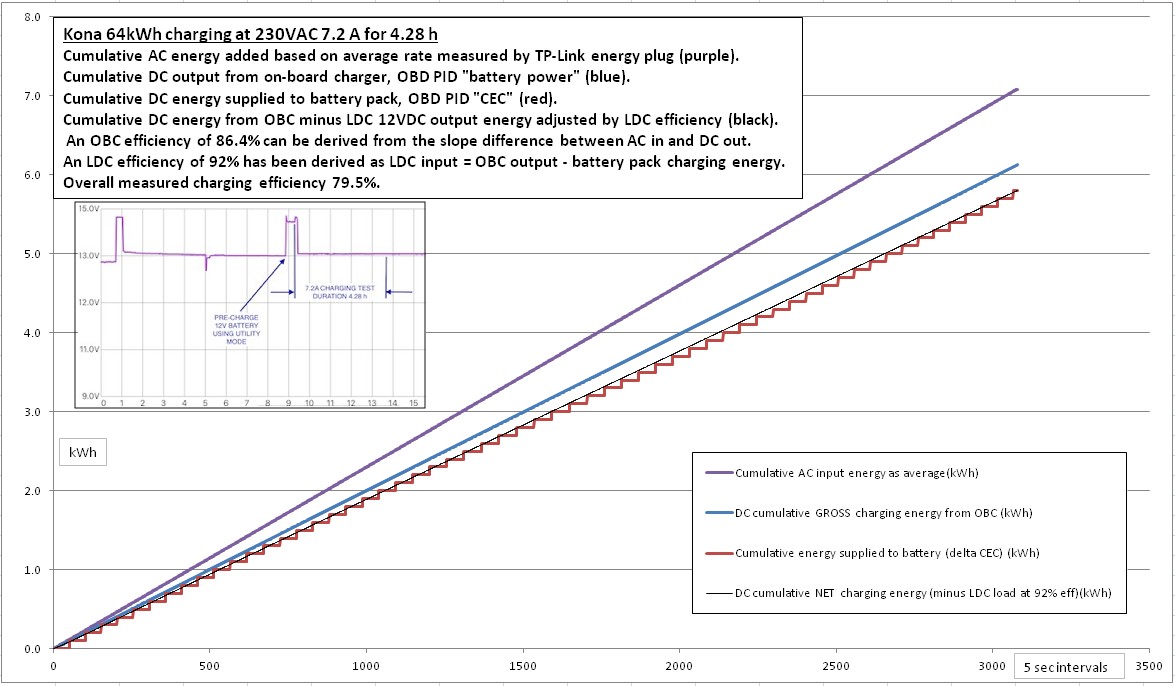
Charging at 1.7 kW my Kona battery gets 79.5% of that according to my careful measurements.  Aside from power conversion losses there is a fixed 200 watts approx needed to keep the car's 12V systems running.  The addition electricity used is an expense I have to balance against the several thousand dollars it would cost to run a suitable 32 amp feed out to my parking space.


Of course with DC we only get billed on the DC side. However, the battery heater can kick-in for a few minutes and skew the measurements.


Create new topic


Geekzone Live »

Try automatic live updates from Geekzone directly in your browser, without refreshing the page, with Geekzone Live now.


Are you subscribed to our RSS feed? You can download the latest headlines and summaries from our stories directly to your computer or smartphone by using a feed reader.