Geekzone: technology news, blogs, forums
Guest
Welcome Guest.
You haven't logged in yet. If you don't have an account you can register now.


View this topic in a long page with up to 500 replies per page Create new topic
1 | 2 
Dingbatt
6804 posts

Uber Geek
+1 received by user: 3694

Lifetime subscriber

  #1345884 17-Jul-2015 07:12
Send private message

As far as windmills in the water go, it would be better to put the blades under the water (I.e. tidal turbines). Production is periodic I know but is totally predictable. One array in Cook Strait would provide a chunk of Wellington's power needs. All for the cost of maybe chipping up a few bottle nose dolphins.
Otherwise, cold frosty morning=no wind and high electricity demand=wind turbines useless.


“We’ve arranged a society based on science and technology, in which nobody understands anything about science technology. Carl Sagan 1996


frankv
5705 posts

Uber Geek
+1 received by user: 3666

Lifetime subscriber

  #1345903 17-Jul-2015 08:27
Send private message

Dingbatt: As far as windmills in the water go, it would be better to put the blades under the water (I.e. tidal turbines). Production is periodic I know but is totally predictable. One array in Cook Strait would provide a chunk of Wellington's power needs. All for the cost of maybe chipping up a few bottle nose dolphins.
Otherwise, cold frosty morning=no wind and high electricity demand=wind turbines useless.


I suspect that it wouldn't take much to protect those dolphins anyway... a grill across the front of the turbine would be all it would take. I'm sure a dolphin can swim faster than the tide. But I think the scale of the turbine would have to be huge to produce significant amounts of power. There would be huge up-front investment in building one. Perhaps it would be cheaper to spend the money on upgrading the Cook Strait cable to move all that underused power northwards?

Given a predicted oversupply of power in the South Island, one would expect that power prices there would plummet. That in turn would mean that industries and people would move move south, which has got to be a good thing.

Or maybe some other large user of electricity might set up shop there?


BlueShift
1692 posts

Uber Geek
+1 received by user: 969


  #1345912 17-Jul-2015 08:44
Send private message

Geektastic:
Handle9:
Geektastic:
timmmay:
cleggy2: If you fly into Copenhagen there are about a thousand turbines in the water, so they don't even take up any space on land.


There are turbines in the water whether you fly in or not... you can just see them better from a plane.


So true!

Do we have any water ones here or is it just our hilltops?

They could build thousands in places like fiordland and no one would ever see them apart from the moose.


Yep and then we would have to invest hundreds of millions in upgrading the distribution system to get the power to where it could be used. If Tiwai Point gets mothballed we'll have the same problem with the Manapouri Dam. A ton of excess generation with no way of getting the power to the North Island where it is needed.

It all sounds very good in theory but it's highly impractical. We need more generation closer to the main centres, not in the South Island.

As I said earlier we have an excess of generation in New Zealand at the moment, and will do for over 5 years, possibly longer due to our dropping industrial base, and energy efficiency measures having very attractive ROIs form large consumers.


Build them in the middle of the East Cape then. No one goes there.

I can just imagine the Nimbys if someone proposed 500 wind turbines just offshore of Auckland!


Better yet, up the West coast, between Urenui and Kawhia. 99% unpopulated, constant reliable westerly winds, build 'em onshore or off, no one will ever see them. If you want it closer to Auckland, between Raglan and Port Waikato, similar deal, mostly farmland.


lchiu7
6521 posts

Uber Geek
+1 received by user: 543

Trusted

  #1346513 17-Jul-2015 20:25
Send private message

This is an interesting paper on NZ's electricity outlook written by MBIE

https://www.med.govt.nz/sectors-industries/energy/energy-modelling/modelling/pdf-docs-library/electricity-insight/electricity-insight.pdf

It notes that thermal and geothermal are suitable for baseload generation (and while not noted, frequency keeping) wind and solar cannot provide baseload nor peak generation.

Geothermal plants are relativity inflexible and must-run baseload generation. Wind plants also must-run but are highly intermittent. Unlike baseload natural gas CCGTs or hydro generators, geothermal and wind power can only make a minimal contribution to meeting peak demand. Investment in flexible peaking capacity, large scale demand side management, and/or energy storage will be necessary, especially if existing thermal plants are retired. These are likely to add costs to the electricity system.

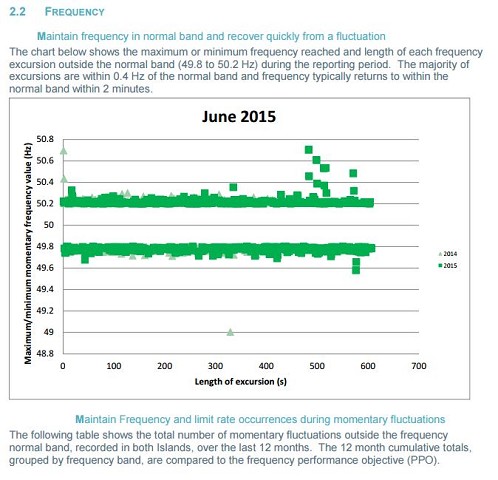
As for frequency keeping which must be done with predictable load like thermal, this is a recent plot from Transpower on how well they have been keeping the frequency in the network


As can been seen the frequency has to be kept with 49.Hz and 50.2Hz else 1) there is a breach of the Electricity Industry Code and 2) the network can go unstable.


So the point made earlier about Denmark exporting its wind power and importing nuclear for baseload reinforces this. Nuclear is also quite suitable for baseload generation but the likelihood of that in NZ is probably zero.

And as others have noted, one of the biggest obstacles to wind generation in NZ is the RMA!


Staying in Wellington. Check out my AirBnB in the Wellington CBD.  https://www.airbnb.co.nz/h/wellycbd  PM me and mention GZ to get a 15% discount and no AirBnB charges.


1 | 2 
View this topic in a long page with up to 500 replies per page Create new topic


Geekzone Live »

Try automatic live updates from Geekzone directly in your browser, without refreshing the page, with Geekzone Live now.


Are you subscribed to our RSS feed? You can download the latest headlines and summaries from our stories directly to your computer or smartphone by using a feed reader.