Geekzone: technology news, blogs, forums
Guest
Welcome Guest.
You haven't logged in yet. If you don't have an account you can register now.


View this topic in a long page with up to 500 replies per page Create new topic
1 | 2 

xpd

xpd
Geek of Coastguard
14116 posts

Uber Geek
+1 received by user: 4579

Retired Mod
ID Verified
Trusted
Lifetime subscriber

  #2918189 24-May-2022 22:08
Send private message

A pro would prob charge an arm and a leg. A geek who knows what they're doing and has the tools, a lot less. 


Most sparkies could do it, probably be best to get a quote.


If all the cable run is Cat5/6, then all they need to do is punch it correctly at each outlet, and put in a patch panel. The patch panel is usually the most time consuming item to do depending how many ports you have. (I have nightmares over the one I had to do years ago for a warehouse, 40+ ports, and was my first time setting one up from scratch - pleased to say it all worked fine :D )


XPD / Gavin


LinkTree


ZKGeorge

10 posts

Wannabe Geek


  #2918208 24-May-2022 22:32
Send private message

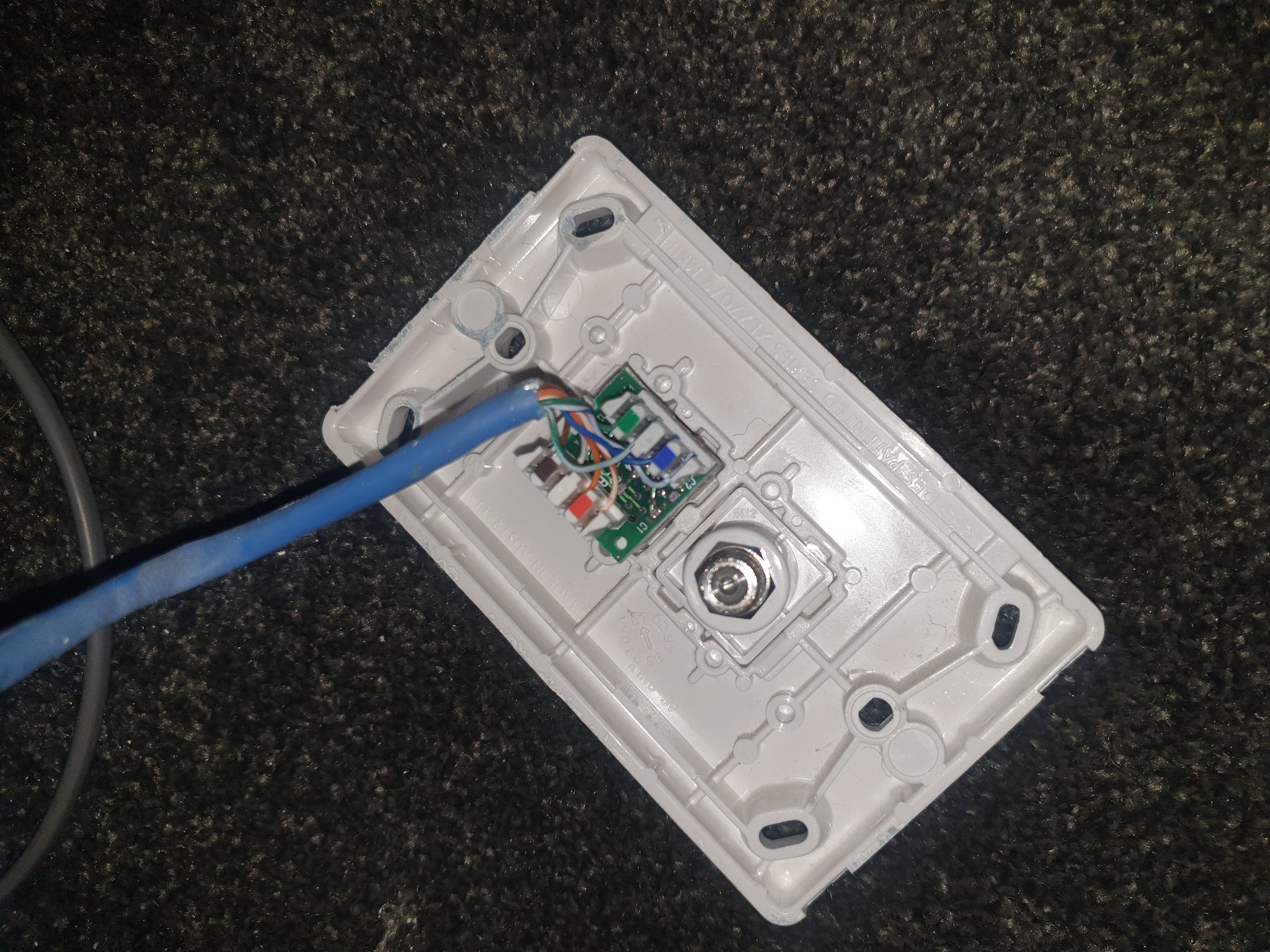
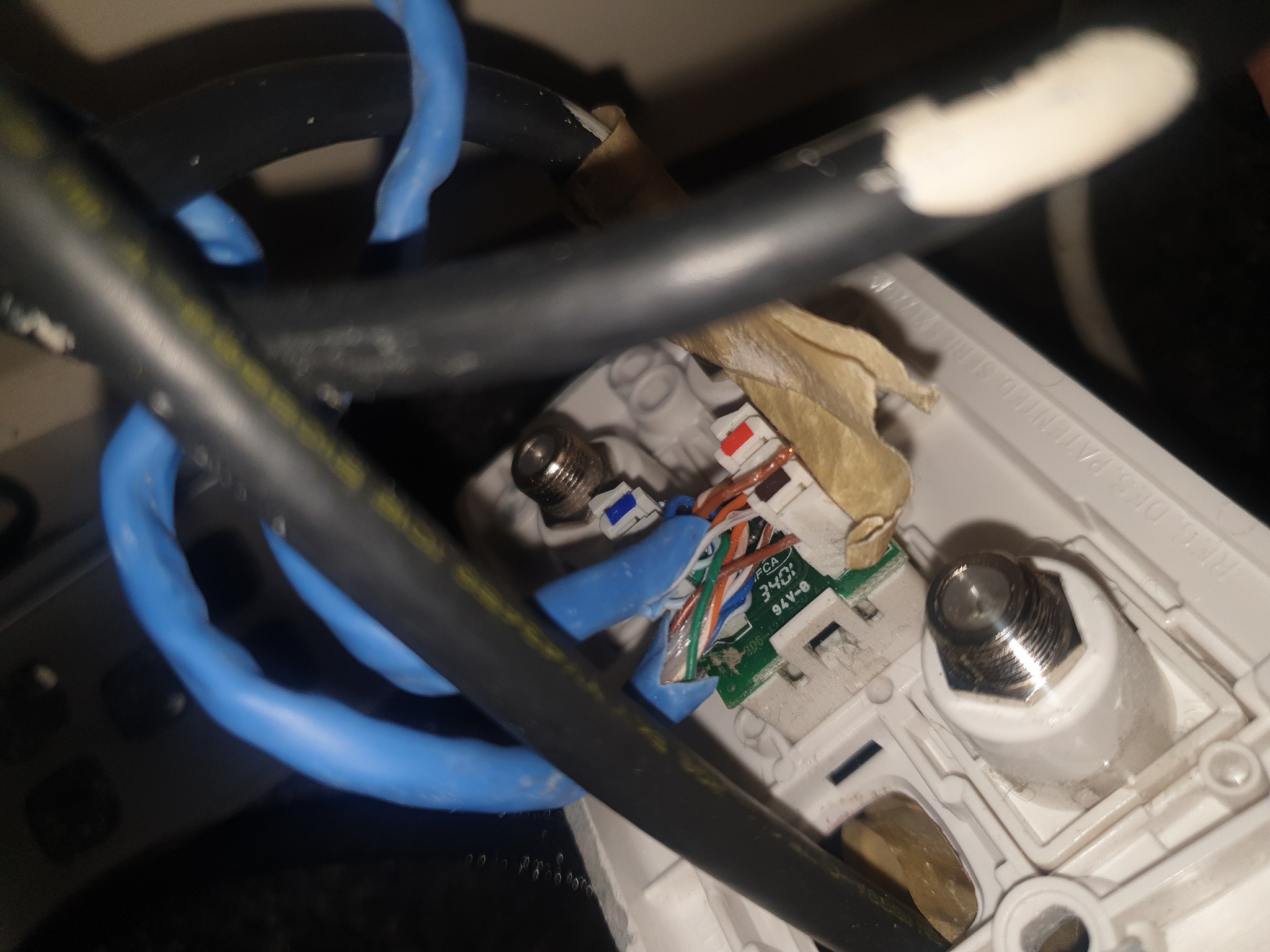
I think the outlets are all good, (or are they not?) it's just the other end of the cables (wherever they go) need to be sorted, well that's what I'm thinking. I have attached a couple photos as to what I'm guessing they all look like. I'm not sure why but one of them has two cables connected to it by the looks of it. I've only looked through a few ports as intially this was totally unrelated; I was speaking to SKY and they wanted me to test out a few ports and on the ports it is a female aerial connection, but when you take the cover off it's a coax connected to the aerial port if that makes sense. So basically an adaptor.


Well anyway, throughout the whole house there are ethernet ports on almost every wall, so it'll definitely be a time consuming job I'll say.


Oblivian
7345 posts

Uber Geek
+1 received by user: 2117

ID Verified

  #2918209 24-May-2022 22:37
Send private message

The right one is a cheeky daisy chain. Probably to another socket.


To have true networking. 1 blue cable per socket, all 4 prs cables punched.


Anything less (or in this case, more than 1 cable in use) is a bit of work ahead.


antoniosk
2382 posts

Uber Geek
+1 received by user: 742

ID Verified
Trusted
Lifetime subscriber

  #2918234 25-May-2022 07:43
Send private message

ZKGeorge:


I think the outlets are all good, (or are they not?) it's just the other end of the cables (wherever they go) need to be sorted, well that's what I'm thinking. I have attached a couple photos as to what I'm guessing they all look like. I'm not sure why but one of them has two cables connected to it by the looks of it. I've only looked through a few ports as intially this was totally unrelated; I was speaking to SKY and they wanted me to test out a few ports and on the ports it is a female aerial connection, but when you take the cover off it's a coax connected to the aerial port if that makes sense. So basically an adaptor.


Well anyway, throughout the whole house there are ethernet ports on almost every wall, so it'll definitely be a time consuming job I'll say.


Appreciate you're trying to save money here, but you've got several hurdles ahead.


The blue cable is almost certainly voice telephone grade. I would hazard all the ports in the house are star wired back to a common point in the junction box, to give every port concurrent dial tone. How they are all joined together (that blue/white pair) is anyone's guess, but very likely to impact what you want to do.


Some visualisation of the ports in relation to the junction might give you an idea - lengths, paths it might have followed etc.


Voice grade copper was typically cheaper and thinner than data quality cabling - thinner copper less resistance longer punch which is fine for analogue voice. Typically it could be pressed into service for a rudimentary 10mbps capable connection.


The wires can be detached for the connector and a new keystone put in on A port and at the other end of the junction, but what the path looks like from A to B is anyone's guess and will impact performance. An experiment can't hurt and should be easy to undo if it doesnt work. But now the costs are beginning, both for parts/tools and time


If it doesnt work though? then it will be a good tech to do the work - I use an electrician for my place and their data cabling skills have been really good, but of course your experience will vary.


The layout of your place is not clear (levels, build type etc), and whether someone can go under the house to pull cables, which is a factor.


________


Antoniosk


trig42
5889 posts

Uber Geek
+1 received by user: 2094

ID Verified

  #2918245 25-May-2022 08:40
Send private message

It's unclear from your photos how many cables end up back in that cabinet.


It does look like they have just daisy chained some of those sockets, which is useless for networking.


You need to find how many cables go from those sockets directly back to the cabinet, and you will be able to use any that do as ethernet. That will mean that you could have Chorus install the ONT at the cabinet, and run from the ONT to your Router over ethernet, having the router somewhere more useful in the house (a lot of times, those cabinets are somewhere you wouldn't necessarily want to put a WiFi access point, like a garage).


hsvhel
1273 posts

Uber Geek
+1 received by user: 596

ID Verified

  #2918263 25-May-2022 09:48
Send private message

Where are you located?


Referral Link Quic


Free Setup use R502152EQH6OK on check out


Shop now on AliExpress (affiliate link).
fahrenheit
757 posts

Ultimate Geek
+1 received by user: 33


  #2918297 25-May-2022 11:25
Send private message

Its probably one big daisy-chain and there is no central terminating location. I know, because I'm in a house that was wired as such.


Fortunately it was Cat5e and I was able to isolate and test every cable and map-out the absolute shambles that the ignorant sparky had created. Once I understood what links were dependent/redundant, I was able to repurpose it for a home network. Not as flexible as a centralized terminal, but better than nothing.


DonH
231 posts

Master Geek
+1 received by user: 158

Lifetime subscriber

  #2918333 25-May-2022 13:06
Send private message

The round black cabling is a TV signal distribution system, likely fed from a roof aerial.


I suspect the blue cable hanging out of the wall in two of the rooms is a room-to-room Ethernet cable.


People hear what they see. - Doris Day


Zeon
3926 posts

Uber Geek
+1 received by user: 759

Trusted

  #2919070 26-May-2022 17:21
Send private message

Looks to be daisy chained from one socket to another which is how old DSL or analogue phones would access the public telephone network. I think star style topology started to become the norm around 2005? Not sure of the age of the house but could be older or electrician not familiar with the no phones/DSL future we were all moving to.


You may need to draw out a map of what goes where as farenheit did and then see if you can get at least some runs back to a central point.


Speedtest 2019-10-14


xlinknz
1141 posts

Uber Geek
+1 received by user: 168

Trusted

  #2919545 27-May-2022 19:11
Send private message

We had a similar challenge in our home (built 2005) all the outlets had modules for BT plugs, I was pleasantly surprised to find these had being all wired with Cat 5E


I replaced with BT modules with RJ45 modules, then terminated the other ends with RJ45 (after buying a crimping tool).


I even get 750Mbit over the Cat5E


1 | 2 
View this topic in a long page with up to 500 replies per page Create new topic


Geekzone Live »

Try automatic live updates from Geekzone directly in your browser, without refreshing the page, with Geekzone Live now.


Are you subscribed to our RSS feed? You can download the latest headlines and summaries from our stories directly to your computer or smartphone by using a feed reader.