Geekzone: technology news, blogs, forums
Guest
Welcome Guest.
You haven't logged in yet. If you don't have an account you can register now.


TZNZ

7 posts

Wannabe Geek
+1 received by user: 6


#303277 29-Jan-2023 14:37
Send private message

Hi, newbie here. Advice needed please on the subject of repurposing our phones to network. We're on fibre for the past year. 
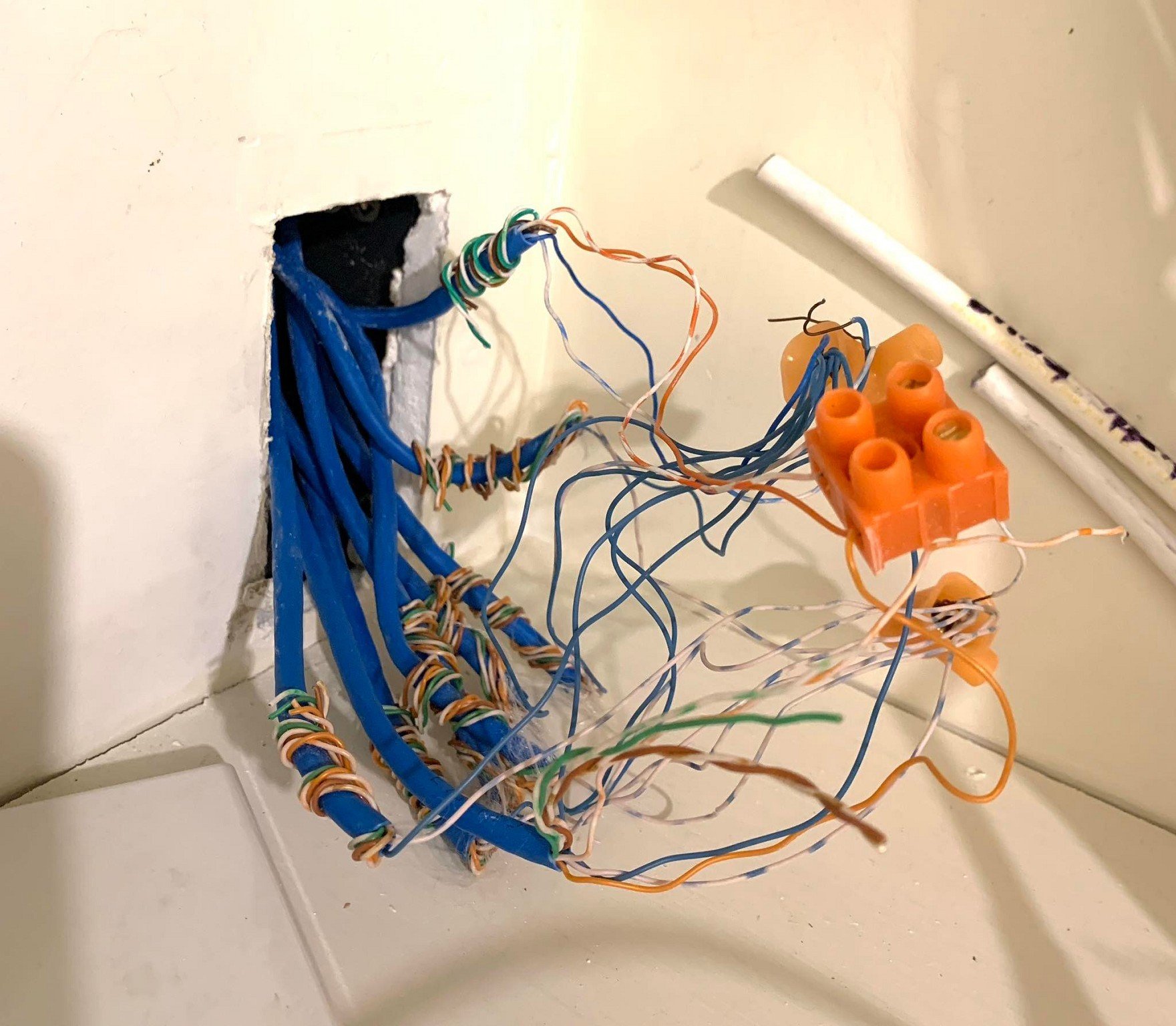
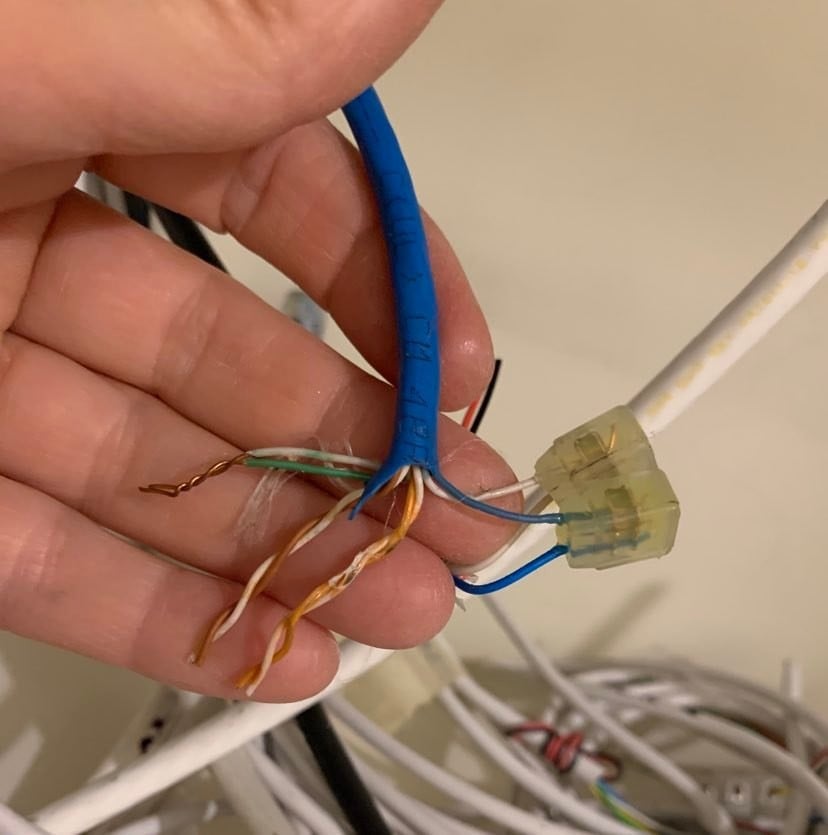
House built 2005. Photo shows what is likely to be CAT5e cables (given the house age) but could be CAT5? 
From what I read it's also about the tightness of the twist. 
The sheath says UTP which means unshielded? Is this a security issue when sending sensitive data. 
Installation in hall cupboard seems to be spiderweb which will make things easier than daisy-chain? 

I've read that... "Cat5e was introduced around 2000 and served as an “enhanced” version of Cat5. It offered the same bandwidth (100 MHz) but was designed to reduce crosstalk and handle speeds up to 1,000 Mbps, making it the first Cat standard capable of supporting Gigabit Ethernet..."

Tomorrow a friend is coming over to use a multimeter to see which cables run between the office (location of the modem/ONT) and living room where the smart TV is. The TV Wifi module is becoming unreliable and hardwiring would be desirable. 
Haven't checked out which jacks /faceplates I'll need or how to wire them will need a Switch in the hall cupboard. 

Any and all advice welcome. Thanks 

View this topic in a long page with up to 500 replies per page Create new topic
 1 | 2
cyril7
9073 posts

Uber Geek
+1 received by user: 2499

ID Verified
Trusted
Subscriber

  #3028889 29-Jan-2023 14:42
Send private message

Hi, that definitely looks like 5e rather than 6 as none of the ends show the remnant of the spine used in Cat6. The cable should state somewhere on it that it was 5e or 5, regardless in 2005 cat5 would not have been available, only cat5e. That all said Cat5 will do GigE without issues in 99% of situations the key details is the cable length if any run is under 70m and Cat5 then there is a 100% certainty it will pass GigE.


Edit: any questions re how to wire them, then ask away, you will need a 110 tool, or a plastic tool is fine if you doing just a few outlets.


https://www.mitre10.co.nz/shop/custom-telephone-socket-wiring-tool-white/p/106736


The following Cat6 mechanisam is readily available at Mitre10 and is a keystone type with a Amdex clip if you want to fit it to HPM faceplates


https://www.mitre10.co.nz/shop/goldair-rj45-wall-plate-network-socket-single-white/p/247770


Cyril


TZNZ

7 posts

Wannabe Geek
+1 received by user: 6


  #3028891 29-Jan-2023 14:50
Send private message

Thanks, that's good to know what cable we're dealing with. 


The sheath has this printed on it (as far as I can read)


E137775-S (UL) CM 4PA. 24AWG UTP 75C — C (UL) CM….


cyril7
9073 posts

Uber Geek
+1 received by user: 2499

ID Verified
Trusted
Subscriber

  #3028893 29-Jan-2023 14:54
Send private message

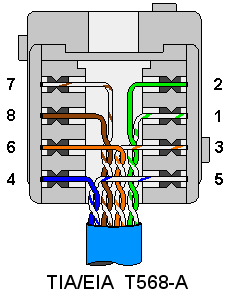
Hi, you should be wiring then in 567A format ie A layout not B, and they should be wired similar or as tidy and tight as the image shown below, the key is not to untwist the wires any more than required, if at all.


Note that each brand/make of connector may have a slight differnce in the wire layout, follow the colour banding as shown on the product you purchase, but using the A layout not B.


Cyril


TZNZ

7 posts

Wannabe Geek
+1 received by user: 6


  #3029056 29-Jan-2023 20:49
Send private message

I'm not finding many wiring diagrams for the 567A format. Plenty for 568A... 

Thanks for the Mitre10 links, will grab those. 


In the hall cupboard I'll be wiring up two males for a Switch as both cables run to this junction.  

Where do you recommend I source the RJ45? connectors...


RunningMan
9184 posts

Uber Geek
+1 received by user: 4833


  #3029059 29-Jan-2023 21:04
Send private message

Easier to punch down to female jacks and use a patch cable than putting plugs on to that solid core cable.


MartinGZ
376 posts

Ultimate Geek
+1 received by user: 128

Subscriber

  #3029060 29-Jan-2023 21:04
Send private message

I think you'll find 567 was a typo, but @cycril7 can put me right if not.


If your friend has a multimeter, perhaps he has the odd RJ45 connector lying around? Failing that any electrical wholesaler and places like Jaycar, PB Tech.


Nokia 6110, 6210, 6234, Sony Ericsson XPERIA X1, Huawei Ideos X5 (Windows Mobile), Samsung Galaxy SIII, LG G4, OnePlus 5, iPhone Xs Max (briefly), S21 Ultra. And I thought I hadn't had many phones - but the first one around 1997.


Shop now for Lego sets and other gifts (affiliate link).
Mehrts
1112 posts

Uber Geek
+1 received by user: 984

Trusted

  #3029064 29-Jan-2023 21:34
Send private message

567 is a typo.


TZNZ

7 posts

Wannabe Geek
+1 received by user: 6


  #3029069 29-Jan-2023 21:55
Send private message

Thanks for the replies. 
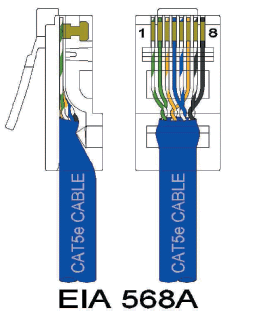
So these diagrams would be correct for the 568A: 


If the intention is to repurpose more than one connection in the house a Switch (in the hall cupboard) is the solution.
If only joining two rooms with cables wired with RJ45s connectors I presume an RJ45 coupler would be all I need?


cyril7
9073 posts

Uber Geek
+1 received by user: 2499

ID Verified
Trusted
Subscriber

  #3029072 29-Jan-2023 22:00
Send private message

Hi sorry 568, I think you all get the gist of it :)


Yes if just connecting two points then a simple patch between is all you need otherwise a switch is required./>Cyril

SomeoneSomewhere
1882 posts

Uber Geek
+1 received by user: 1086

Lifetime subscriber

  #3029076 29-Jan-2023 22:15
Send private message

TZNZ:


Thanks for the replies. 
So these diagrams would be correct for the 568A: 


If the intention is to repurpose more than one connection in the house a Switch (in the hall cupboard) is the solution.
If only joining two rooms with cables wired with RJ45s connectors I presume an RJ45 coupler would be all I need?


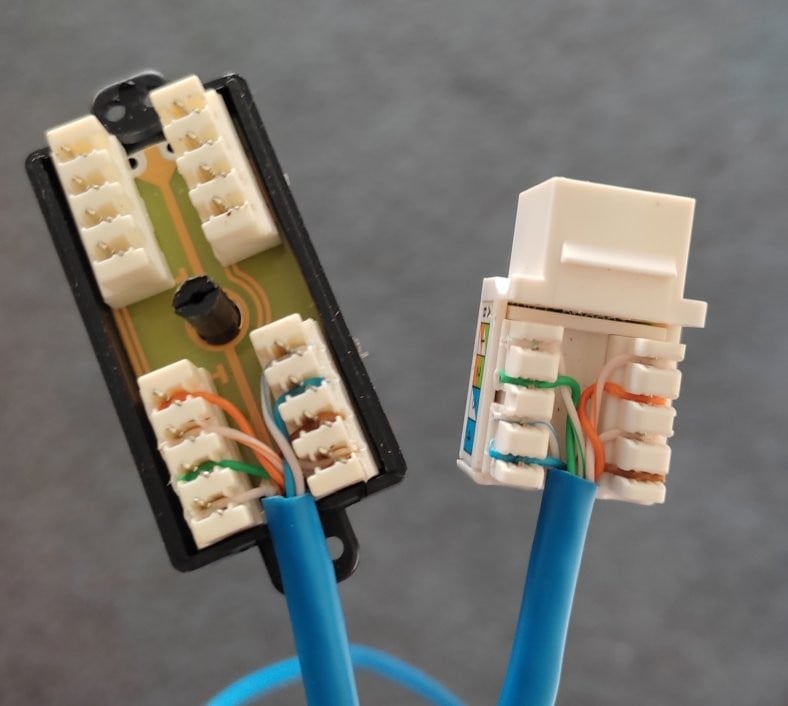
For the plug, yes. For the jack, you need to follow what is printed on the jack. It will have an 'A' and 'B' colour scheme and pretty clearly show what goes where. Different manufacturers route them differently. Post pictures of your actual jack if you have trouble.


This guide is pretty questionable in terms of workmanship (don't use scissors...), but step three pretty clearly shows the A and B markings on a typical jack.


If you only want to join two rooms, then the best option is a punch-down inline coupler. It's less connections than jack - patch cable - jack and also more reliable than plug - coupler - plug. Plugs on solid-core building wiring should normally be avoided.


TZNZ

7 posts

Wannabe Geek
+1 received by user: 6


  #3029735 30-Jan-2023 18:07
Send private message

It took five hours but we finally nailed it. After exhaustive testing and not getting continuity through all pairs (36 pairs in nine separate lines) we discovered there was one 'branch' and we were testing though that. 
As soon as we went back to the primary jack it worked just fine. We wired up two RJ45 female connectors (office and living room) then twisted the pairs in the cupboard till I get the inline coupler - and faceplates.

Thanks for all the advice, it's been really helpful in knowing what needed to be done before starting the job.
Cheers for that.


HP


Shop now for HP laptops and other devices (affiliate link).
tweake
2641 posts

Uber Geek
+1 received by user: 1137


  #3029758 30-Jan-2023 19:18
Send private message

cyril7:


Hi, you should be wiring then in 567A format ie A layout not B,


any reason for A instead of B ?


Jase2985
13730 posts

Uber Geek
+1 received by user: 6202

ID Verified
Lifetime subscriber

  #3029764 30-Jan-2023 19:33
Send private message

personally use B at home, and really shouldn't matter as long as both ends are the same


There is no official standard for NZ


SirHumphreyAppleby
2938 posts

Uber Geek
+1 received by user: 1860


  #3029772 30-Jan-2023 19:49
Send private message

The only time I've ever seen a recommendation for one wiring standard over another is with HDMI extenders. Those don't use Ethernet (well, some do), so in those rare circumstances the distance between conductors and the fact that they are twisted at different rates may be relevant, but for Ethernet, it makes absolutely no difference which standard you use.


antoniosk
2382 posts

Uber Geek
+1 received by user: 742

ID Verified
Trusted
Lifetime subscriber

  #3029779 30-Jan-2023 20:19
Send private message

TZNZ:


It took five hours but we finally nailed it. After exhaustive testing and not getting continuity through all pairs (36 pairs in nine separate lines) we discovered there was one 'branch' and we were testing though that. 
As soon as we went back to the primary jack it worked just fine. We wired up two RJ45 female connectors (office and living room) then twisted the pairs in the cupboard till I get the inline coupler - and faceplates.

Thanks for all the advice, it's been really helpful in knowing what needed to be done before starting the job.
Cheers for that.


Bet you felt a good deal of satisfaction once it was wired up :-)


Be interesting to hear what sort of continous speeds you've been able to get through end to end. Computer with ethernet at one end with the other connected to your router is usually a good way to start.


________


Antoniosk


 1 | 2
View this topic in a long page with up to 500 replies per page Create new topic


Geekzone Live »

Try automatic live updates from Geekzone directly in your browser, without refreshing the page, with Geekzone Live now.


Are you subscribed to our RSS feed? You can download the latest headlines and summaries from our stories directly to your computer or smartphone by using a feed reader.