Geekzone: technology news, blogs, forums
Guest
Welcome Guest.
You haven't logged in yet. If you don't have an account you can register now.


View this topic in a long page with up to 500 replies per page Create new topic
1 | 2 | 3 | 4 | 5 | 6
elpenguino
3578 posts

Uber Geek
+1 received by user: 2941


  #3216997 11-Apr-2024 10:27
Send private message

I wouldn't drive a relay directly from a GPIO pin. If you add a transistor you'll get a lot more drive current and avoid problems like weak latch-up.


If you really want to drive directly, look at solid state relays. I am guessing you won't find many mains contactors with 5 volt coils, let alone 3.3v.


Shellys are cheap, easy to interface and DIN mountable (with 3D printed bracket). I wouldn't take the time to use an arduino or other DIY solution unless I really wanted some custom code to do something special.


Most of the posters in this thread are just like chimpanzees on MDMA, full of feelings of bonhomie, joy, and optimism. Fred99 8/4/21


neb

neb
11294 posts

Uber Geek
+1 received by user: 10018

Trusted
Lifetime subscriber

  #3217124 11-Apr-2024 15:33
Send private message

EgorNZ:

Any recommendation for a suitable contactor that can be controlled by a Shelly?


Yes, see this post, that's what I'll be using for the HWC control.

neb

neb
11294 posts

Uber Geek
+1 received by user: 10018

Trusted
Lifetime subscriber

  #3217127 11-Apr-2024 15:35
Send private message

elpenguino:

If you really want to drive directly, look at solid state relays.


... bought from somewhere other than Aliexpress.


Also unless you're doing a lot of switching an SSR probably isn't worth the extra cost, particularly since you then need to take the considerable waste heat they can generate into account.


neb

neb
11294 posts

Uber Geek
+1 received by user: 10018

Trusted
Lifetime subscriber

  #3217128 11-Apr-2024 15:36
Send private message

SirHumphreyAppleby:

If you need a Shelly, plus a contactor, I question the sense of using a Shelly in the first place given the additional complexity that comes along with it (e.g. Wifi dependency, odd MQTT naming based on the device ID). I'd rather just drive a relay with a GPIO pin on a Pi or Arduino.


The Shelly integrates directly into HA, which is a huge plus point for it.

Username1
76 posts

Master Geek
+1 received by user: 7


  #3217208 11-Apr-2024 22:32
Send private message

elpenguino:

Whoa. Not good. What was the HWC heater rating ?


It is a 3kW HWC. When I asked the first electrician if it would be fine he said yes because the box said 16A.

The Shelly was reporting temperatures around 20 degrees lower after a firmware update so that might have had something to do with the shortened life and it died reporting 70 degrees.

I currently have a A9C20732 contactor installed by another electrician which seems to be working ok. Only thing I didn't realize was the noise it creates. The on off is very loud and the buzzing noise when the HWC isn't drawing power is very annoying and I can hear it in the kitchen and the room next to it. I only keep it on for an hour a day now as that seems to be enough time to heat it back up and so I don't have to hear that loud humming noise from the contactor.

rbensonx
30 posts

Geek
+1 received by user: 7

Subscriber

  #3249563 16-Jun-2024 11:00
Send private message

So the obvious (to me at least) question here is what SHOULD you use to control HWC and for me, give me wifi control that I can automate in HA and monitor consumption. Whilst I can't comfirm or deny I'd install a Shelly uni or 1PM for low loads and appropriate use cases this is one I'd get my Sparky to install, preferably in the fuse box. Also interested for something like a 17kw ducted heat pump. 


Have solar, battery backup, wifi enabled appliances, the odd shelly etc and want to complete the map of energy usage for the big consumers.


For what they are Shelly's are awesome but Im wary of pushing any limits with them. A heated towel rail, gate controller, led downlights are fine I think


Shop now for Dell laptops and other devices (affiliate link).
MadEngineer
4591 posts

Uber Geek
+1 received by user: 2570

Trusted

  #3249642 16-Jun-2024 13:01
Send private message

You ask your electrician to install a DIN-mounted contactor/relay that is controlled by your Shelly module


You're not on Atlantis anymore, Duncan Idaho.

SomeoneSomewhere
1882 posts

Uber Geek
+1 received by user: 1086

Lifetime subscriber

  #3249646 16-Jun-2024 13:11
Send private message

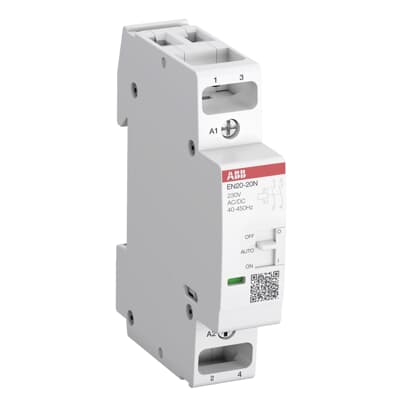
A contactor is the usual part. Something like an ABB EN20-20N is a go-to part. Available in 24V AC/DC or 230V coils. Bigger versions available up to 100A (and more in other series). The integrated auto-off-manual switch is handy.


Most modern AC units have a way to disable them or disable the compressor (fan only operation) without actually cutting power - commonly used in hotel applications where the AC cuts when the keycard isn't in the slot, or for demand response. Contactors need to be oversized for motor loads like compressors compared to resistive heating loads.


SSRs can be driven directly by MCUs (maybe with a transistor), but while DIN-rail mount versions are available, they don't usually have the stick-through-the-front-panel arrangement that breakers and the above contactor use. They're just a brick that's DIN mounted, to be installed in an control cabinet (probably fan cooled) with other gear that only qualified people access.


If a Shelly was involved, I'd want it on a 6A control/lighting circuit, if not smaller. 


richms
29109 posts

Uber Geek
+1 received by user: 10225

Trusted
Lifetime subscriber

  #3249665 16-Jun-2024 14:51
Send private message

Compressors now are usually inverter driven so the loads on startup are managed by their control electronics. It is very rare to see a domestic install like the horrid ones that go on in the US with their ducted systems and direct online or capacitor start/run singlephase motors.


Richard rich.ms

SomeoneSomewhere
1882 posts

Uber Geek
+1 received by user: 1086

Lifetime subscriber

  #3249666 16-Jun-2024 14:57
Send private message

I'm not sure how well controlled the inrush is on the inverters, though. Closing power into a capacitive load can be just as bad as opening power on an inductive one.


And it's still a case of a 30A-ish load once you start looking at the big ducted ones. 


Many control boards have a link that can be removed/switch to inhibit operation. Some have express DRM 1/2/3 terminals that limit compressor duty. Far better to do that than completely disconnect power. Do the wall controllers typically have a battery backup on the clocks?


rbensonx
30 posts

Geek
+1 received by user: 7

Subscriber

  #3249667 16-Jun-2024 15:01
Send private message

Thanks guys. Yep the Shely and the contractor is clean and delivers everything except the power monitoring I want. Have a ducted heat pump that is integrated into HA which gives me better control than the proprietary app and allows me to modify what parts of the house are heated at what time based on actual temperatures and not just scenes. Works well.


Shelly do a DIN mounted 1PM, the Shelly Pro 1PM but again it is 16A max. And S I'm erring on the side of caution and sticking to <5A


From the Shelly site...


"I want to control a load above 16A and monitor his consumption. What device should I use?"


"Our recommendation is to use Shelly EM/3EM, Shelly Pro 3EM with external contactor relay."


Want to support Geekzone and browse the site without the ads? Subscribe to Geekzone now (monthly, annual and lifetime options).
SomeoneSomewhere
1882 posts

Uber Geek
+1 received by user: 1086

Lifetime subscriber

  #3249670 16-Jun-2024 15:16
Send private message

You can assume that the HWC is drawing 3kW, and use a current-operated switch as in input to your automation gear. You could also use a power meter with a pulse output .


It doesn't look like you could use a CT to feed the shelly, as you can't separate the contact from the ammeter, and switching the secondary side of a CT is a massive no-no.


PSLog

291 posts

Ultimate Geek
+1 received by user: 13


  #3252096 23-Jun-2024 14:18
Send private message

Hi Guys

I'm the initiator of this thread.

I can report that I have now been using 2 Shelly 1PMs for the last 13 months.
One controls the socket that charges my EV at 8A.
The other controls my 2kW hot water cylinder, also at around 8A.

Both devices are typically "on" for just 3 hours between 3am and 6am.
HWC is on every night
EV is on, maybe, 2-3 times a week.

To this point, I've never had a problem with either.

Hope that helps someone who may be contemplating going down this route.

cjkbarnett
37 posts

Geek
+1 received by user: 18


  #3277597 31-Aug-2024 22:20
Send private message

I have a 2.4KW Thermann cylinder, surely the Shelly 1PM Gen3 would be ok with that?


neb

neb
11294 posts

Uber Geek
+1 received by user: 10018

Trusted
Lifetime subscriber

  #3277600 31-Aug-2024 22:57
Send private message

cjkbarnett: I have a 2.4KW Thermann cylinder, surely the Shelly 1PM Gen3 would be ok with that?


Looking at the internals, it's a Hongfa miniature relay and dodgy-as-f ChongX capacitors, and when you look at the copper traces there's about 1mm spacing between the heavy-duty mains links but only maybe 1/10mm between them and the low-level signal lines... I wouldn't use it.


1 | 2 | 3 | 4 | 5 | 6
View this topic in a long page with up to 500 replies per page Create new topic


Geekzone Live »

Try automatic live updates from Geekzone directly in your browser, without refreshing the page, with Geekzone Live now.


Are you subscribed to our RSS feed? You can download the latest headlines and summaries from our stories directly to your computer or smartphone by using a feed reader.